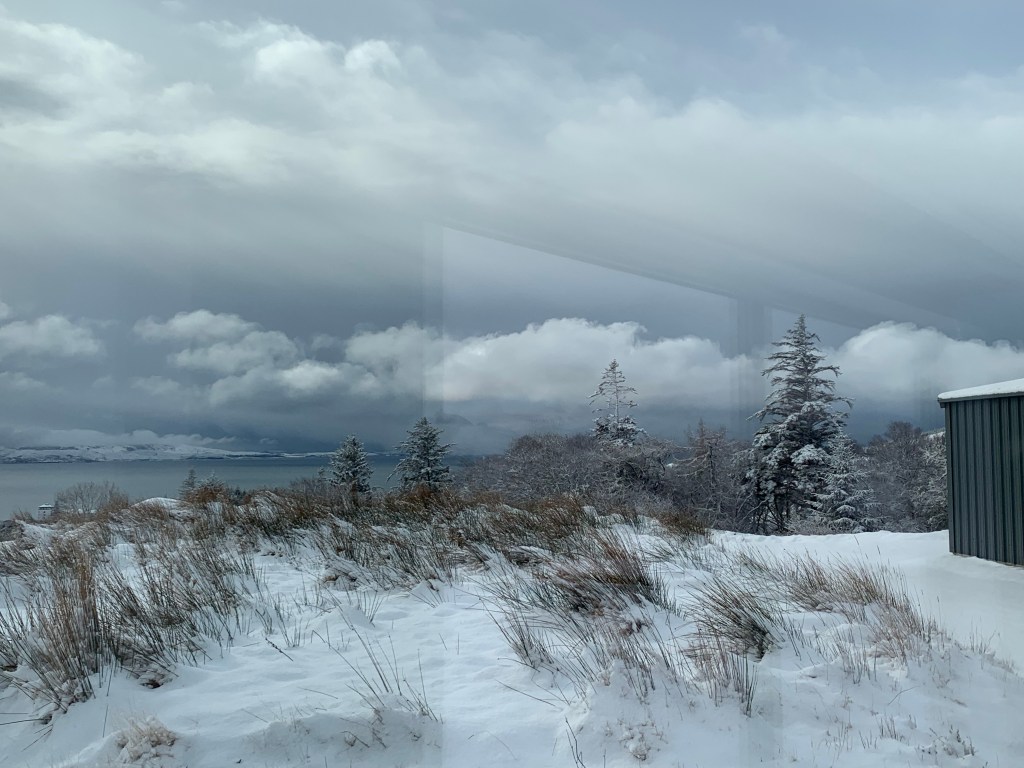
We awoke a few days ago to a silent white landscape. Quite magical in its way with the snow blanketing the building rubble in a sanitising coat of white.
White morning
But clearly way too cold to put any tender plants out into the unheated polycrub anytime soon.
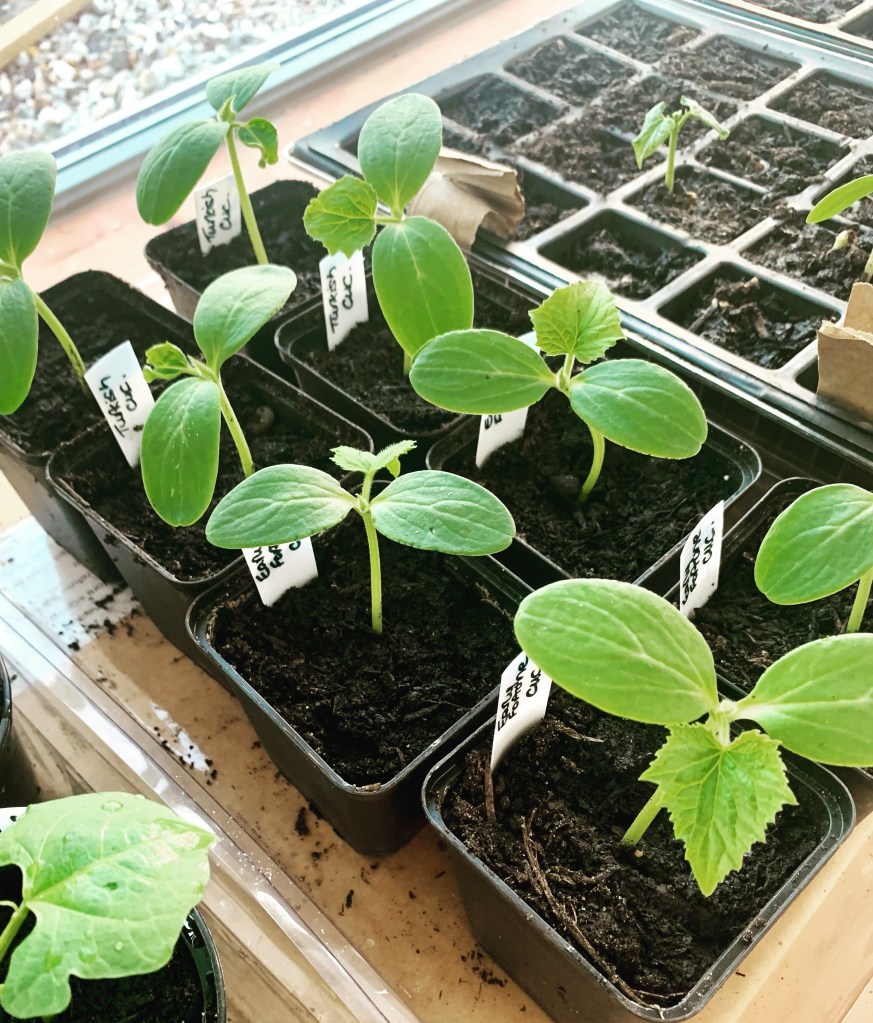
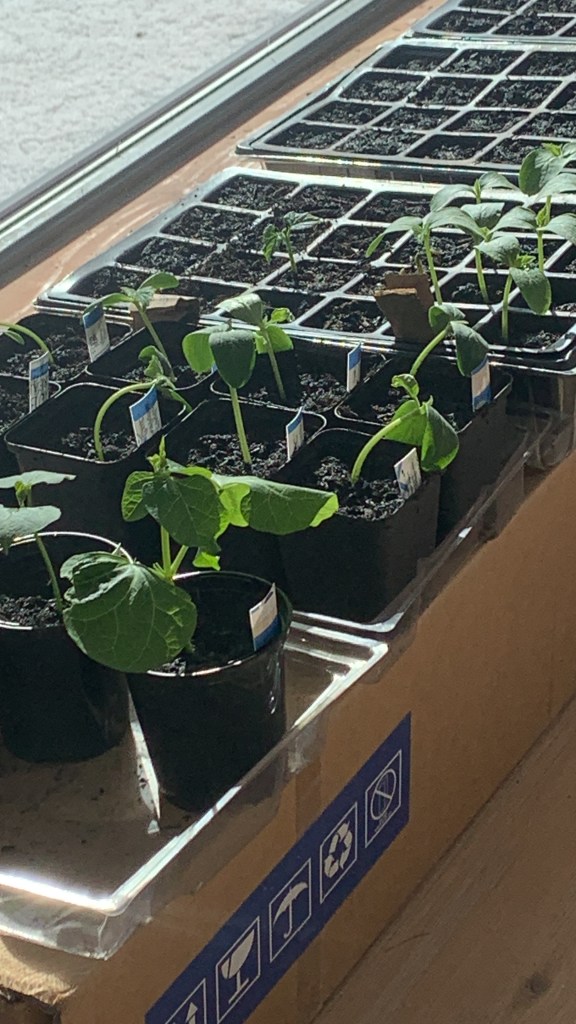
We’ve had a bit of a mixed result with our early seed germination, and a further week of late snow here on the island. I think that some of the seeds took one look at the weather outside and thought, no way..
The cucumber and beans raced up to meet the world, but the chillies, kale, tomatoes and lettuce have been more reluctant to emerge into this chilly white landscape. And I can’t blame them.
The locals call February “false spring” as we enjoy gloriously bright, sunny days at this time of the year. It’s quite stunning.
But winter still has the land in its icy grasp and snow in March and April often follows. Plant out at your peril. It’s still frozen hard under those beams of trickster sunlight.
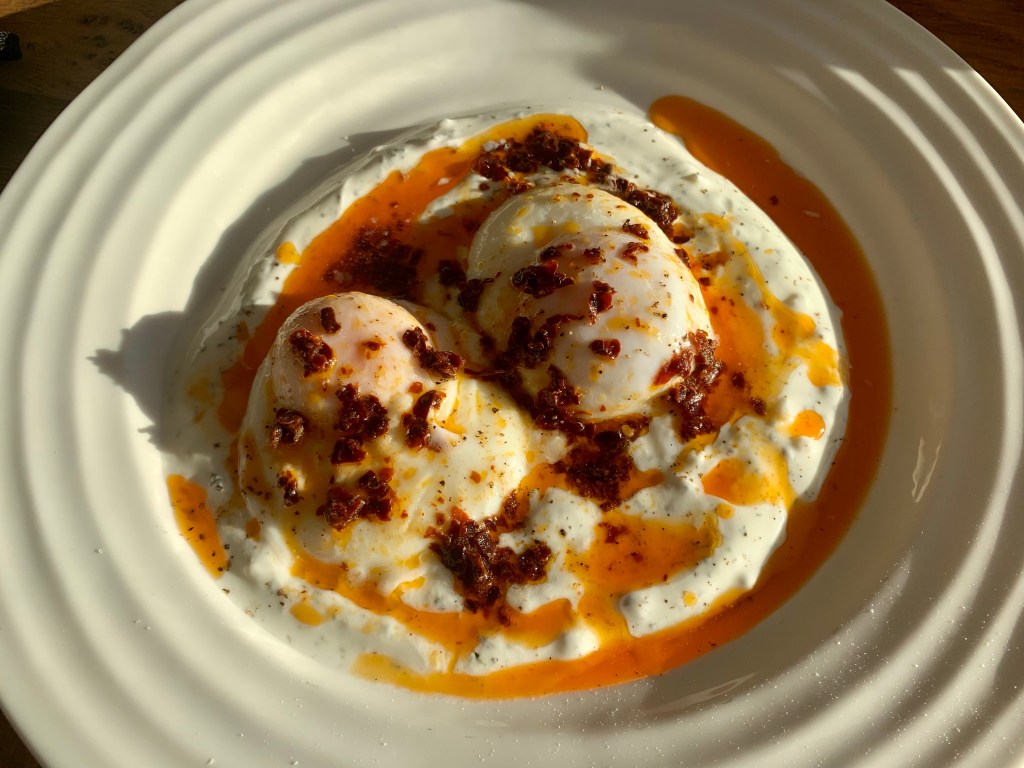
These are still days for big, warming breakfasts, pots of tea by the fire and much watching of the weather from the warmth of the sofa.
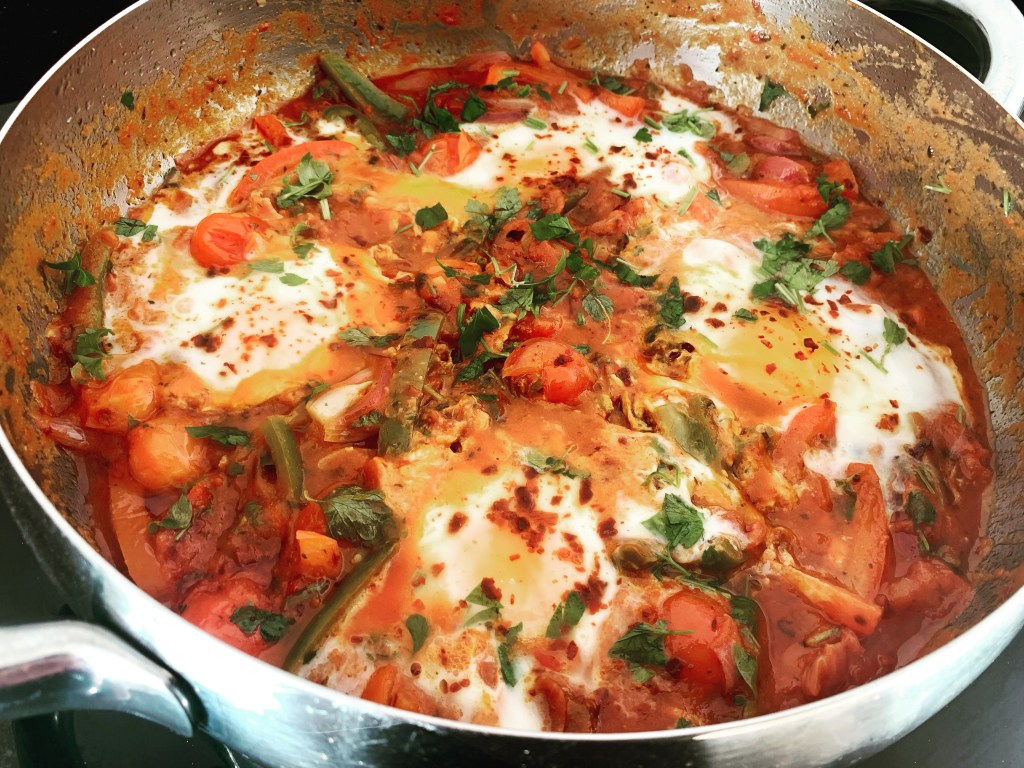
Çılbır, poached eggs with yoghurt and peppery butterShakshuka for breakfast
We’ve been struggling with very wet days for the last month. The croft is saturated and the burn is constantly in full spate.
It’s also bizarrely mild for this time of the year. Two years ago when we moved in around now there was snow on the hills and it was about 8°C colder. This week the day temperature has been hovering around 16°C , like a Highland summer, and my plants are all very confused.
Everything still growing
I still pop into the polycrub a few days each week to weed, water and harvest what’s ready even though this is supposed to be the down season.
This week I transplanted thirty tatsoi seedlings (Asian winter greens) into larger pots and although I’m horribly late with them it will be an interesting experiment to see if they still grow. The pak choi has done well and it’ll be good to try fresh new green things over winter.
Tatsoi seedlings everywhere
Even when it’s grey, it’s still beautiful. This is a snap I took of the cloud inversions sweeping across the Knoydart mountains this morning from the croft. I don’t think I’ll ever get blasé about this view.
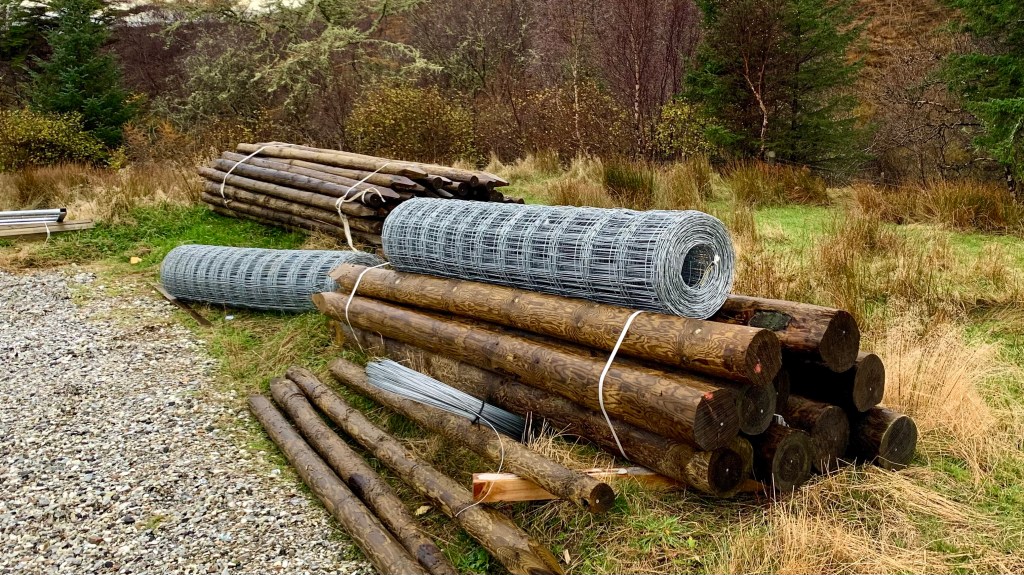
The deer are here in such numbers now that it’s almost impossible to grow anything unprotected in our outdoor croft raised beds. We’ve been left with no choice but to fence off an area if we want to get any harvests next year. A job for next spring, I think.
The posts and wire have arrived already. When it’s built, the fence will be eight feet tall, which is far from great to look at, but is sadly necessary.
I can’t wait to curl up by the Woodburner in the house this winter and plan out the protected growing area. The orchard will have several varieties of heritage apple, pears, damsons and maybe we’ll try cherries too.
I’ve slowly been clearing the polycrub of pots of spent summer produce, the tomatoes, beans and squash plants all now cropped and done. The remaining green tomatoes are coming indoors to be made into chutney any day soon.
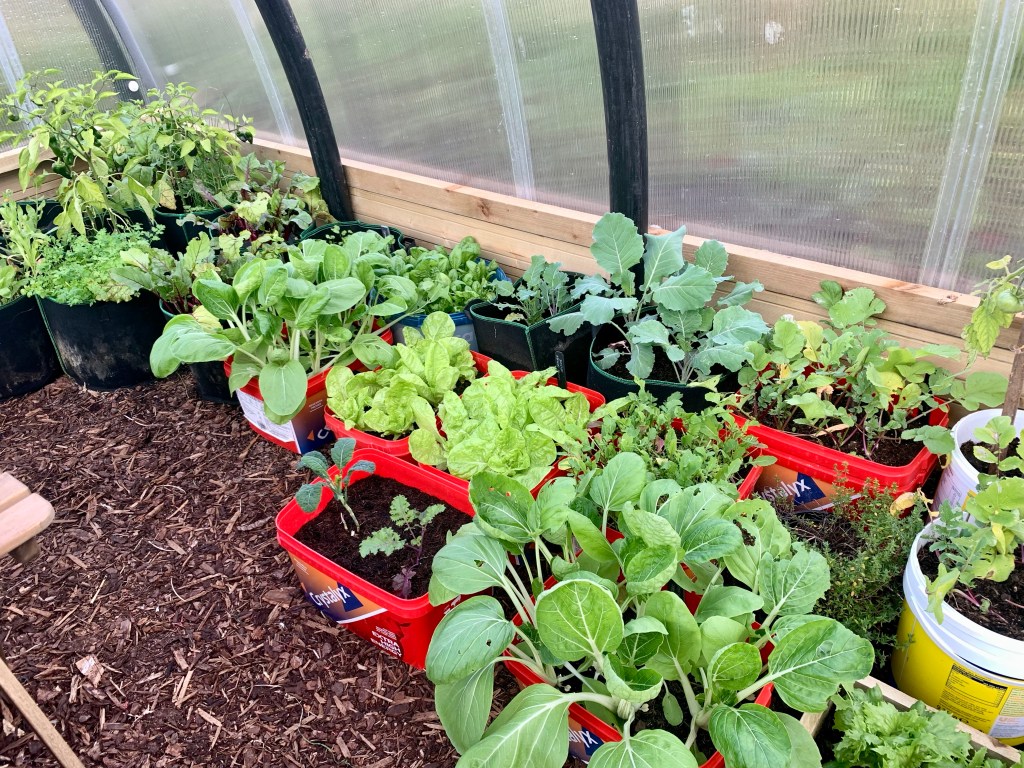
Winter crops in tubs
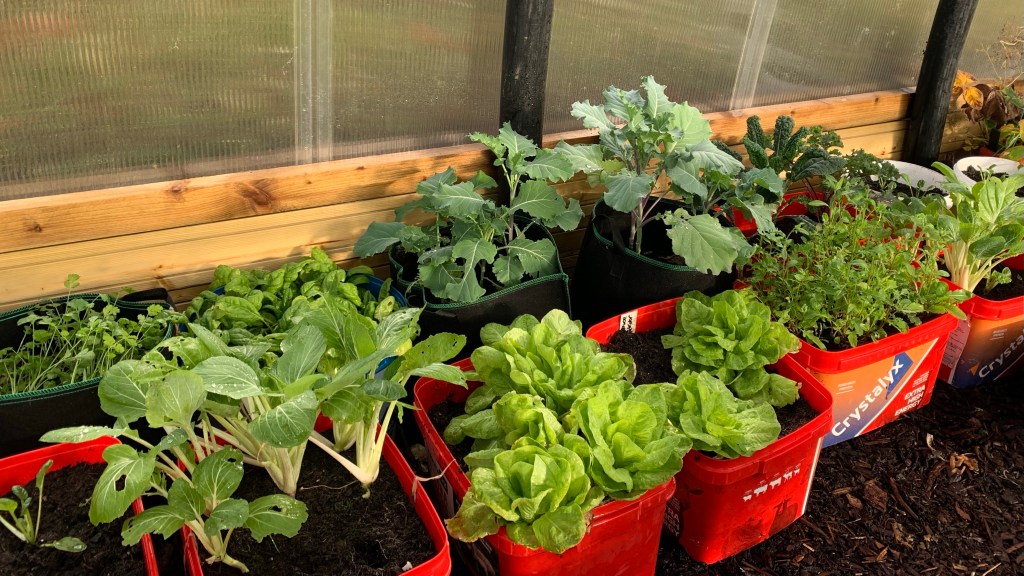
The winter sowings are largely in and have been growing like weeds. I planted winter lettuce and pak choi – too closely together, it seems, as I was short of tubs – expecting slow growth and plenty of time to pot them on once everything else was cleared.
But their rapid growth has taken me aback and we’ve been cropping lettuce and rocket for weeks now trying to thin it all out. They’re just about under control again.
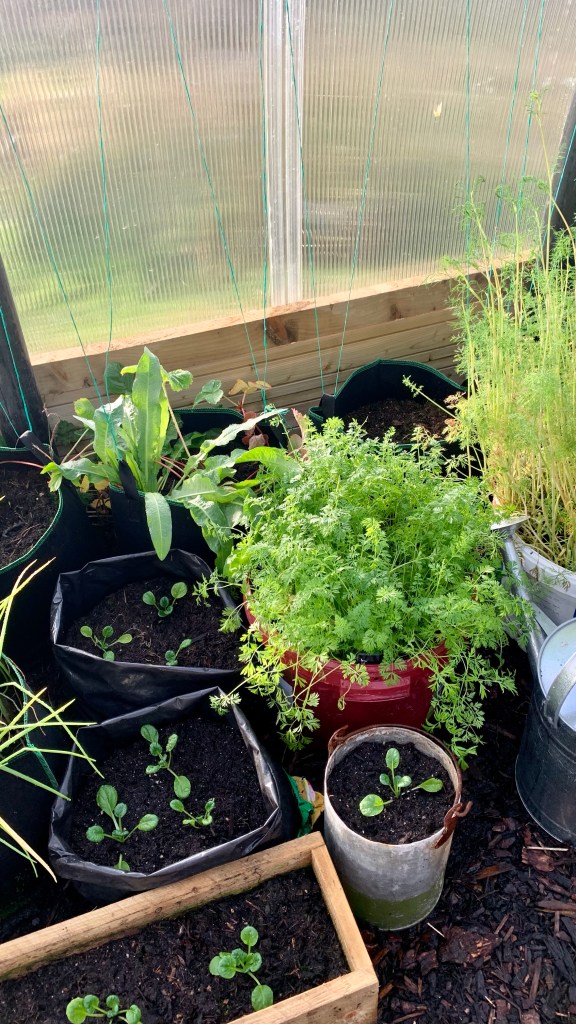
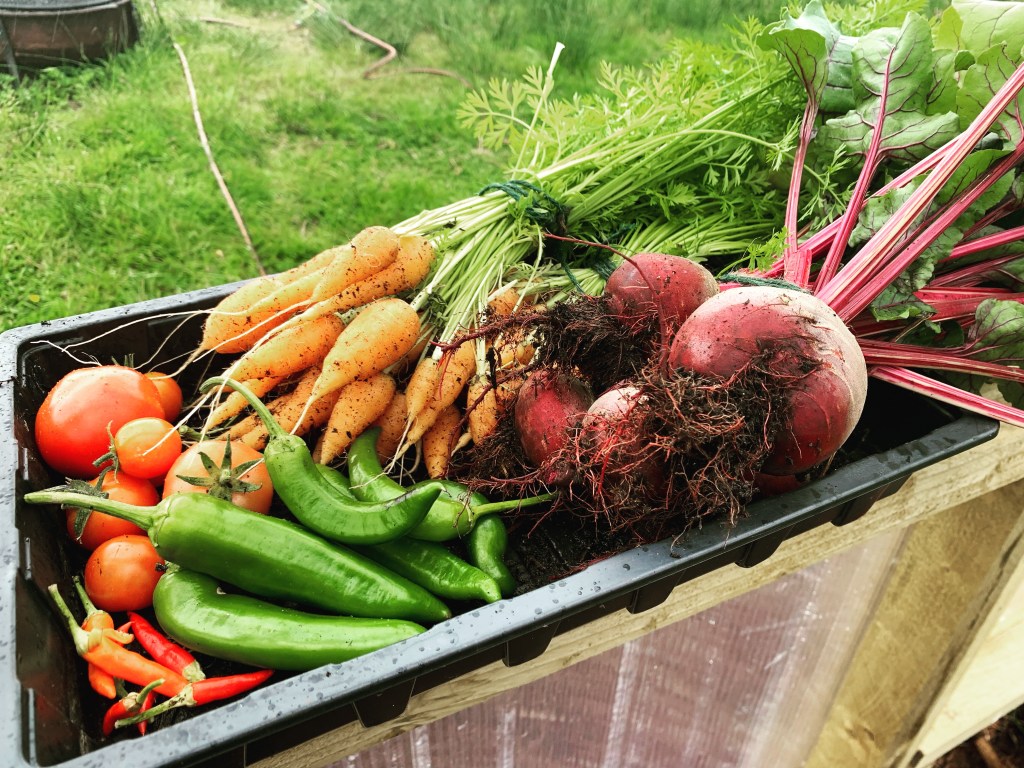
The late August sowings of carrots have done really well. I tried growing a few tubs of Real Seeds French heritage carrots to see what would thrive. They’ve all grown well, but our favourite is a variety called d’Esigny which is a small, blunt tipped carrot with an incredible sweetness of flavour.
Yesterdays harvest with D’Esigny carrots
I shall fill tubs with this variety next year so that we have plenty, and succession-sow so that they ripen every few weeks for staggered consumption. I don’t think they’re a storing carrot, but that’s fine by us as they’re so delicious that they wouldn’t last anyway.
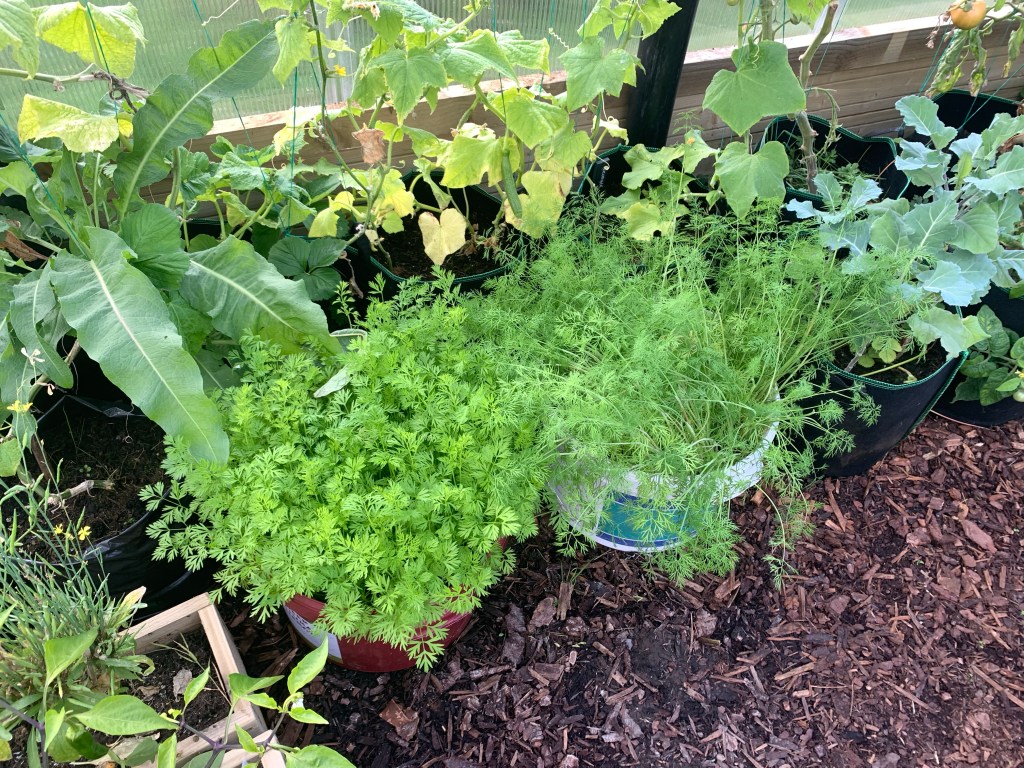
Carrots in tubs, dill, kale
The winter vegetables that have been planted up in the polycrub are purple sprouting broccoli, kale, winter lettuce, pak choi, tatsoi, rocket, carrots, beetroot, parsley, coriander and dill (not sure that dill will make it through winter). Let’s see what survives!
The nights are drawing in now, with a nip in the air and the fire in the caravan going on most evenings to keep the temperature comfortable. I wrap up in a blanket to watch films in the evening as the temperature drops. The electric blanket has gone back onto the bed.
The nights are properly dark again – which seems so strange after a summer of light. It’s awe-inspiring to look up and see the stars once again in clear, inky black skies. The clarity here with no light pollution is remarkable.
This year has been full of experiments of the vegetable variety.
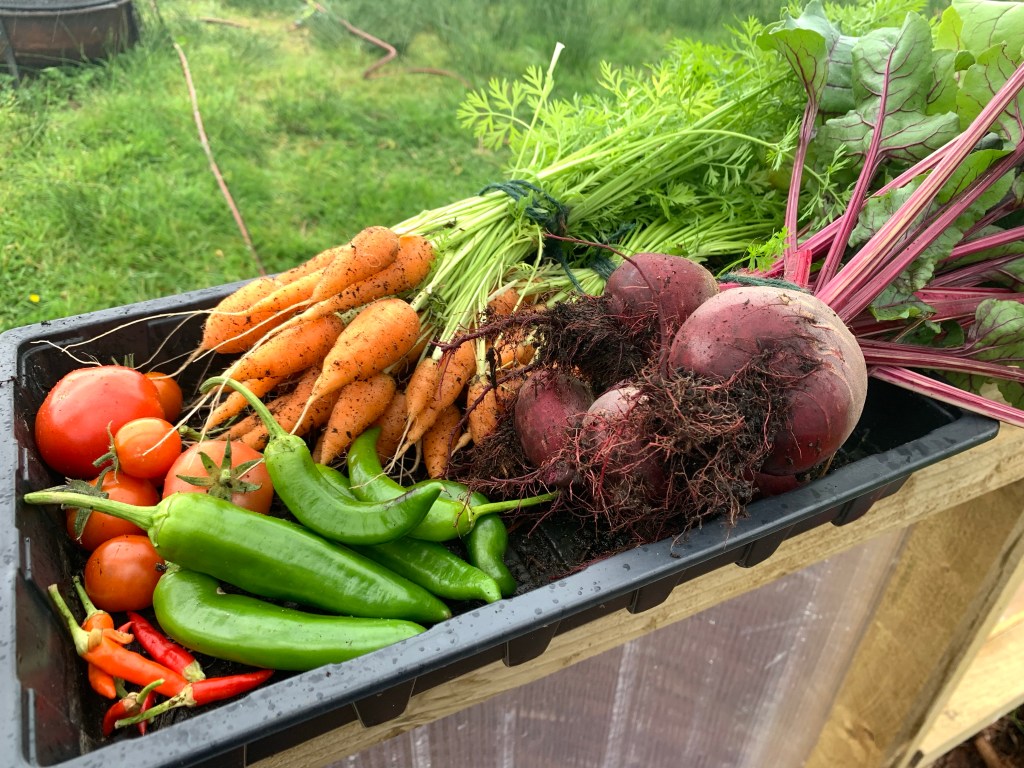
Tomatoes, red hot chillis, mild chillis, carrots, beetroot
It’s been the first year with the polycrub and growing in containers rather than beds. I started rather late in our short season, as the polycrub wasn’t built until the end of April. All of which meant that my expectations were set at a pretty low level for success.
And those expectations have largely been fulfilled ..
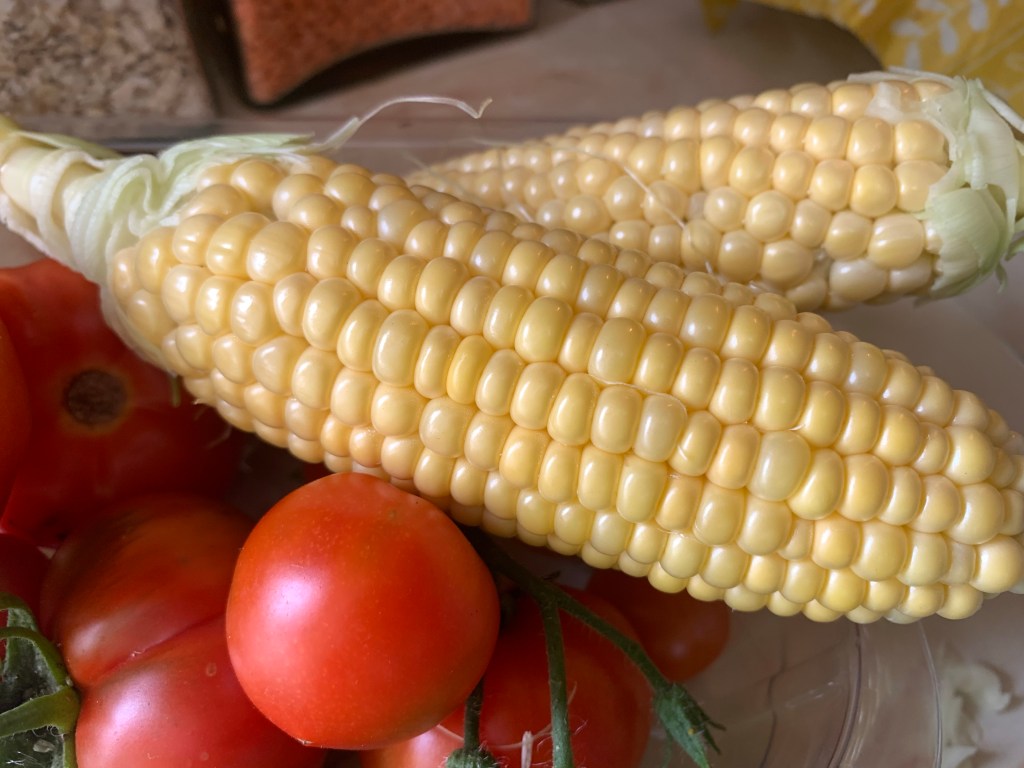
However, there have been a few pleasant surprises. Today I harvested my first cobs of sweetcorn. They’re small, it’s true, and there are only a few of them. But when I planted the corn seeds in May, followed by our largely sunless non-summer I really didn’t think that anything would come of them.
Sweetcorn – yay!
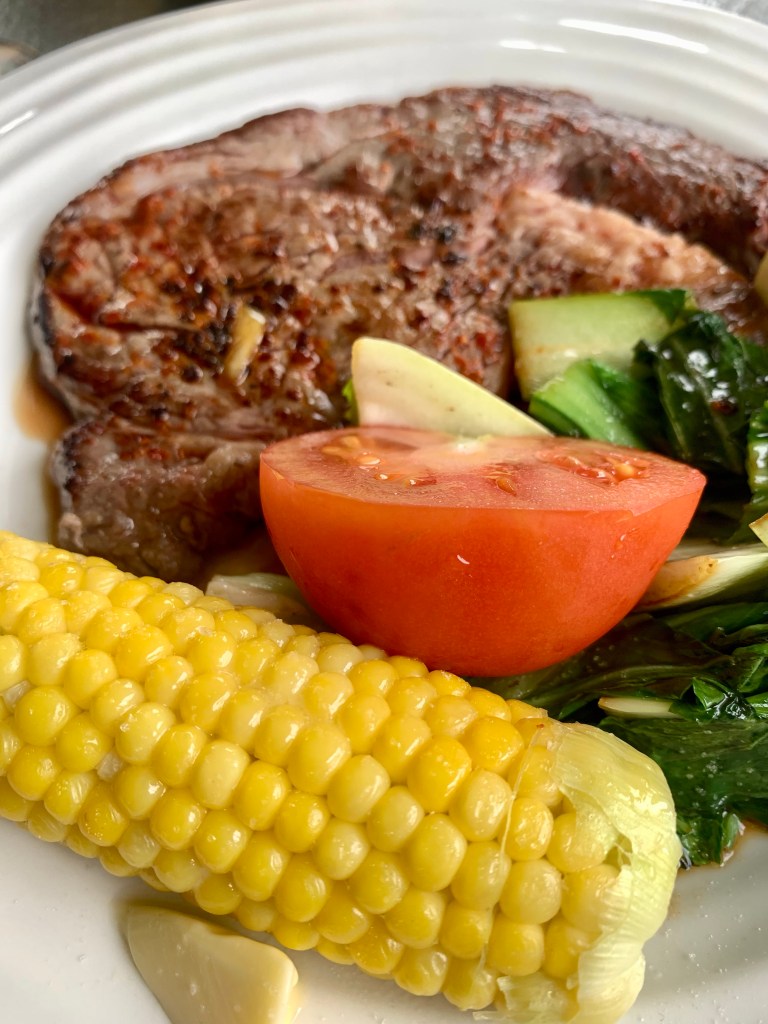
And yet here we are, eating sweetcorn from the croft with our supper. I’m a bit amazed that I’ve managed to produce something so seemingly exotic out of our cold, wet island.
I know that all growers are convinced that their produce is wonderful, but I’m a critical grower, honestly. Our tomatoes have been prolific but disappointing in taste this year and there are some plants, lovingly tended, that have not thrived or produced a harvest worthy of a repeat next year. However, this corn was absolutely delicious, an hour from plant to plate. Sweet and very succulent.
I stand in awe of the tolerance that some plants have for less than ideal environments. It gives me great hope for next years food production which will be in deep beds, fertilised with our own seaweed and croft compost.
A world apart in terms of taste!
Fifty seven degrees north. Who would have guessed!
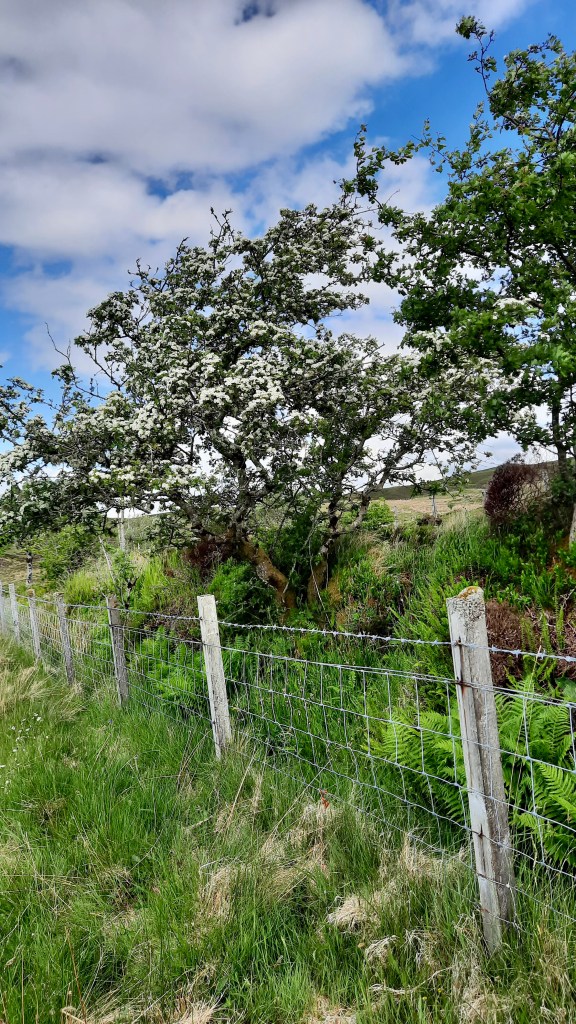
The stock fencing around the croft is ancient and very rickety. We have plans to rip it up and replace it with deer fencing as soon as time and funds permit, but for now it hasn’t seemed a huge priority with the house build taking up all our time and energy.
However, recent events may have promoted fencing repairs to move up the priority list a bit more rapidly.
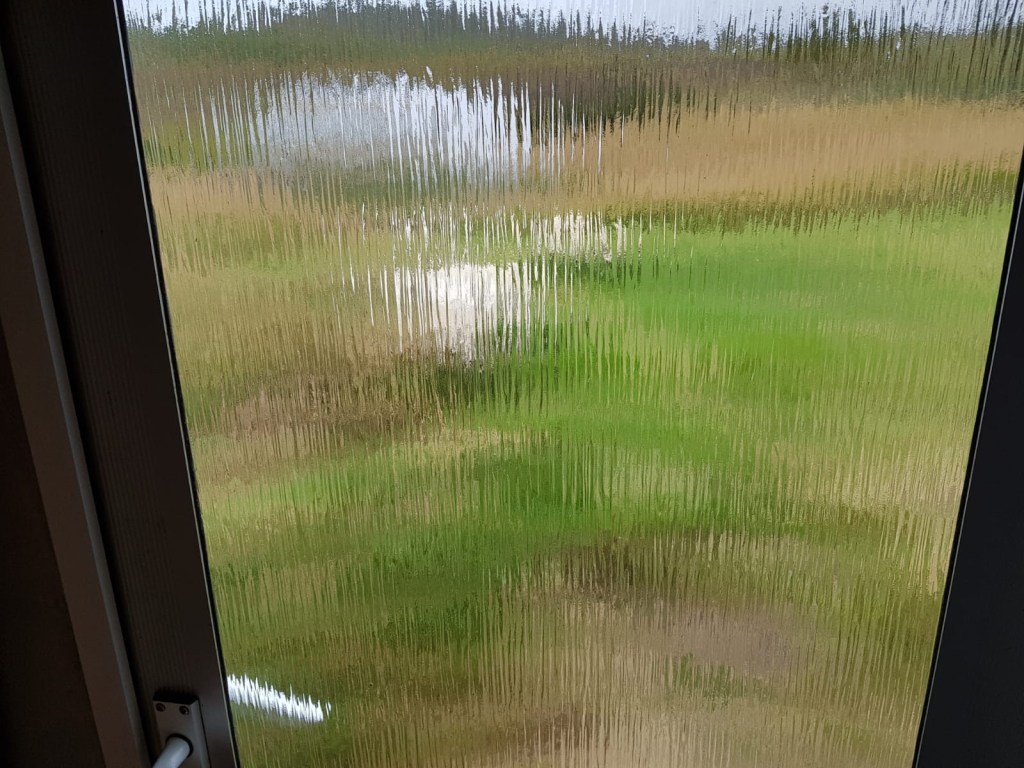
Yesterday evening Husband noticed some ghostly white shapes through the obscured glass of the caravan door as he was walking through to the bedroom.
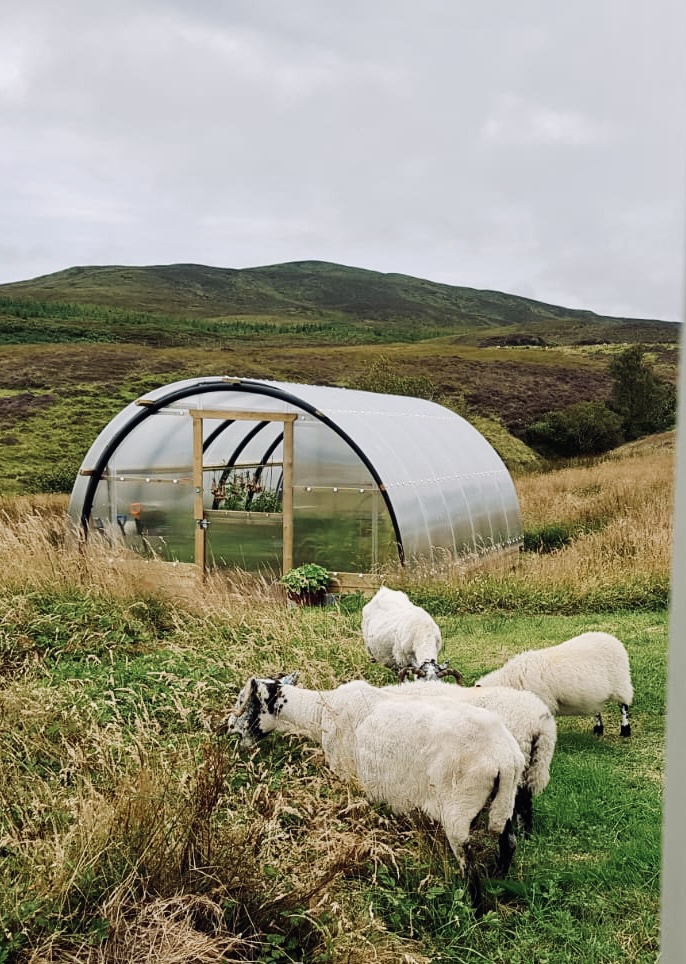
Little ghostly white blobs on the grass…
Spectral forms they were not, unfortunately.
Rory’s sheep, tempted by the long, lush grass on our unkempt croft, had broken through the fencing and were chomping away like demons right outside the caravan!
They’ve also grazed all the purple sprouting broccoli, red cabbage and kale in the croft beds down to sad looking stumps. There goes our outdoor winter crops. As if we didn’t have enough competition from the deer!
From now on, until we have the fencing repaired or replaced, all our growing goes on in the polycrub only, where at least there’s some protection from hungry mouths. I’m going to try and sow some replacements, even though it’s late in the season.
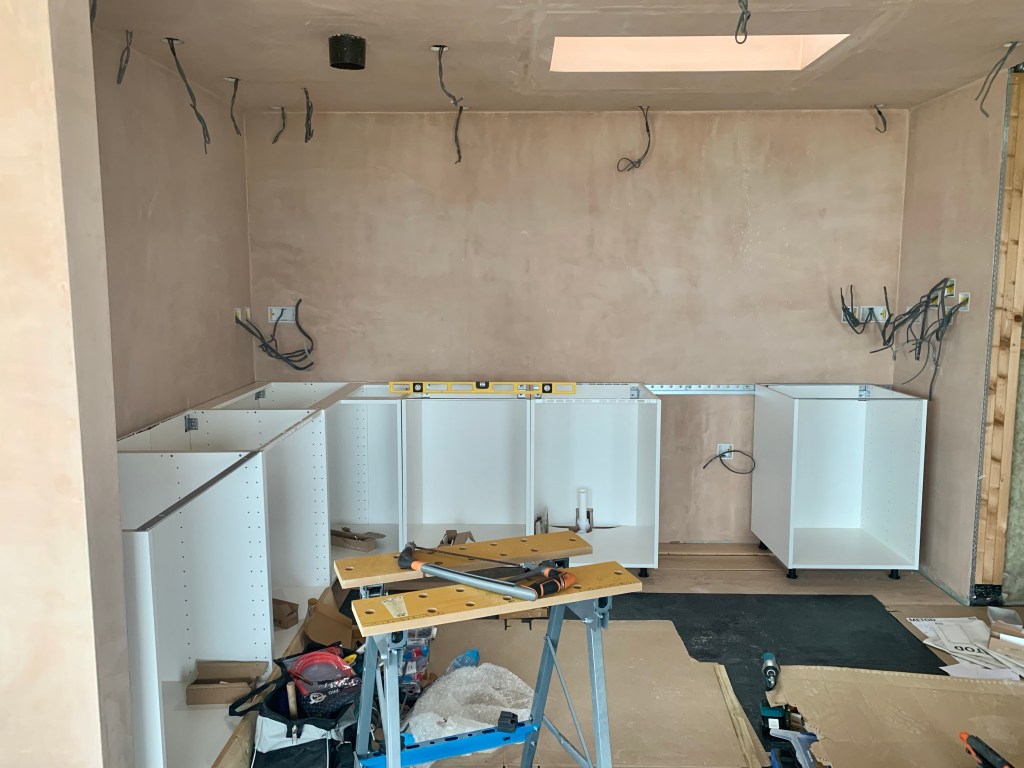
On a brighter note, good progress is being made in the house. We have the carcasses being built in the kitchen in preparation for the template guys to come in later in the week and measure up for the worktops.
I can almost imagine it now! The hob arrived yesterday and we’ve just ordered the fridge. It’s taking shape.
We’ve not had much in the way of a summer yet despite us being at the end of July, but the croft and the polycrub continue to feed us.
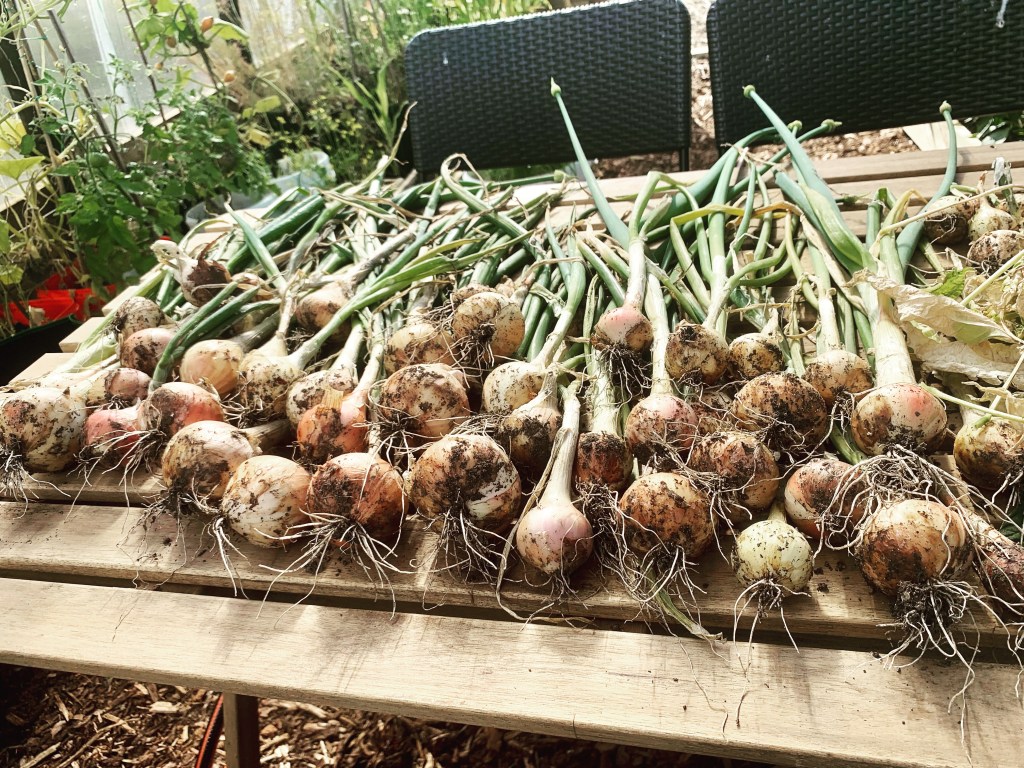
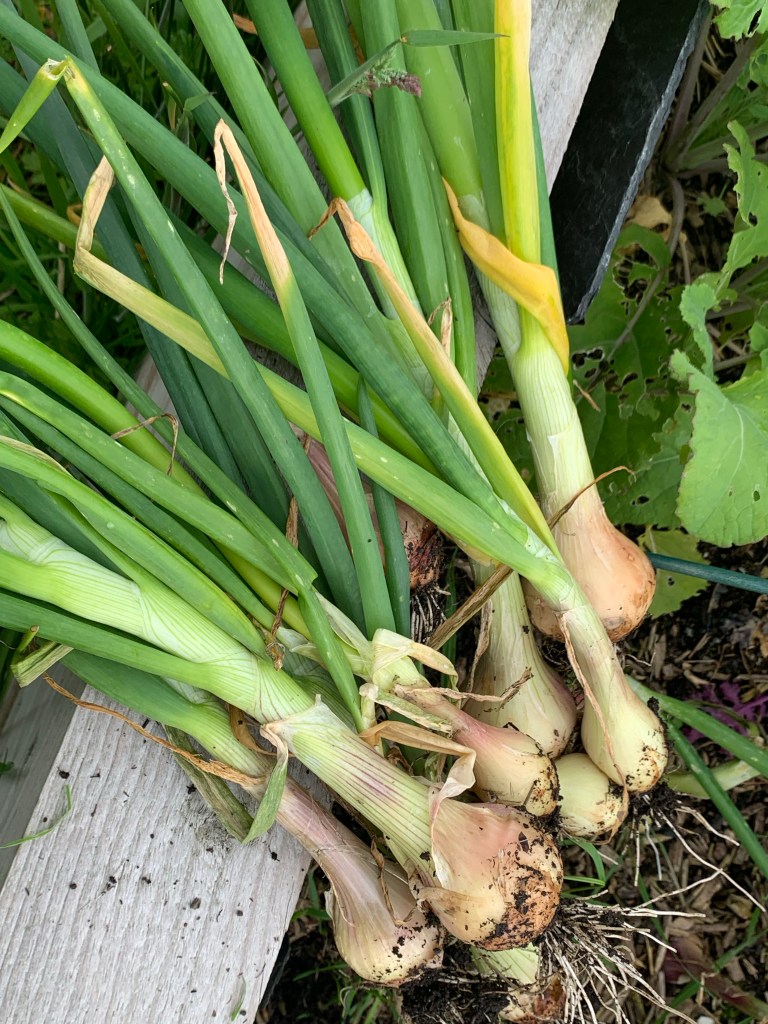
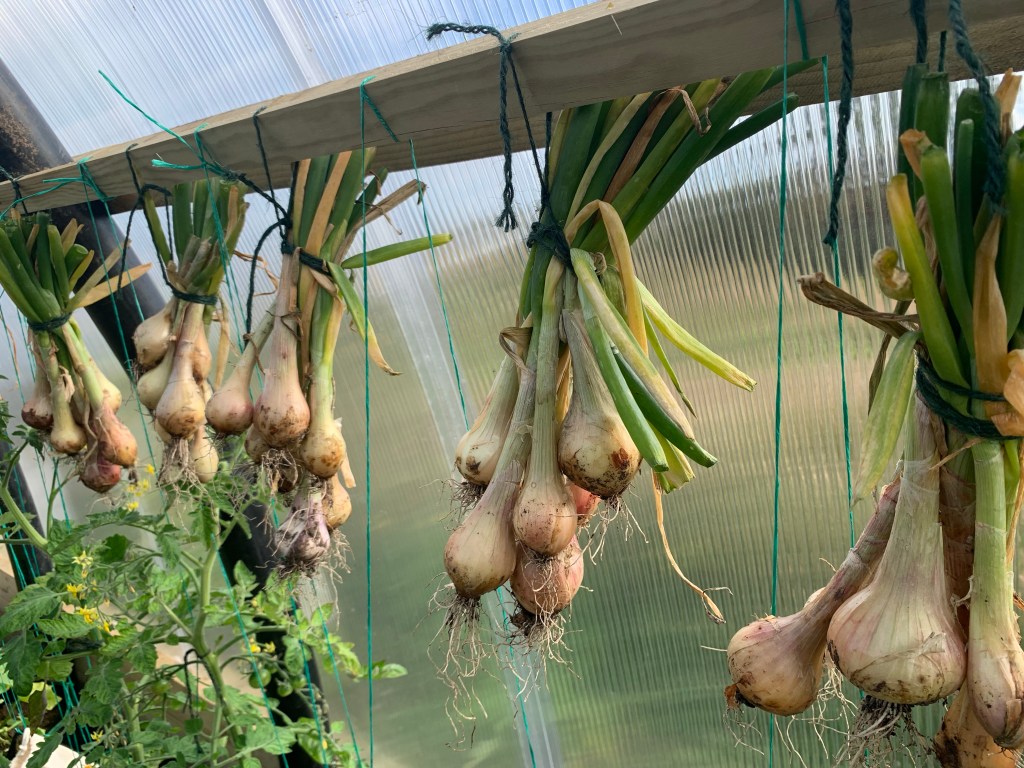
We dug out the rest of the onions yesterday. These are a variety called Keravel Pink, and they’ve produced what I think is quite a respectable harvest.
I chose these as they were the closest I could find to the Roscoff onions that I used to love when I lived in France. They’re an onion with a slightly blush colour, and sweet, firm flesh. They’re now hung up to dry, ready for use.
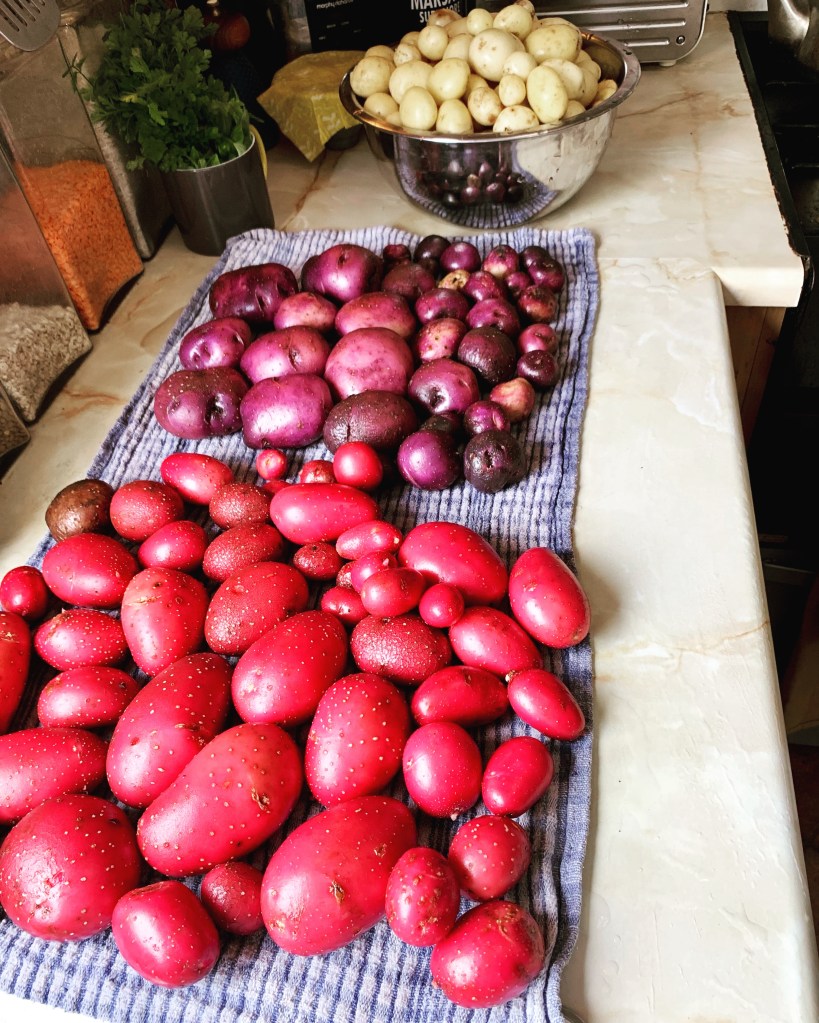
Husband also dug the rest of the potatoes as we were starting to detect slug – and believe it or not, deer damage. We’ve had a few meals already from them. It’s a smaller crop than last year, probably caused by the cold, wet weather and they could have done with a bit longer in the ground, but they’re a reasonable size. To be honest, we like ‘em small and sweet.
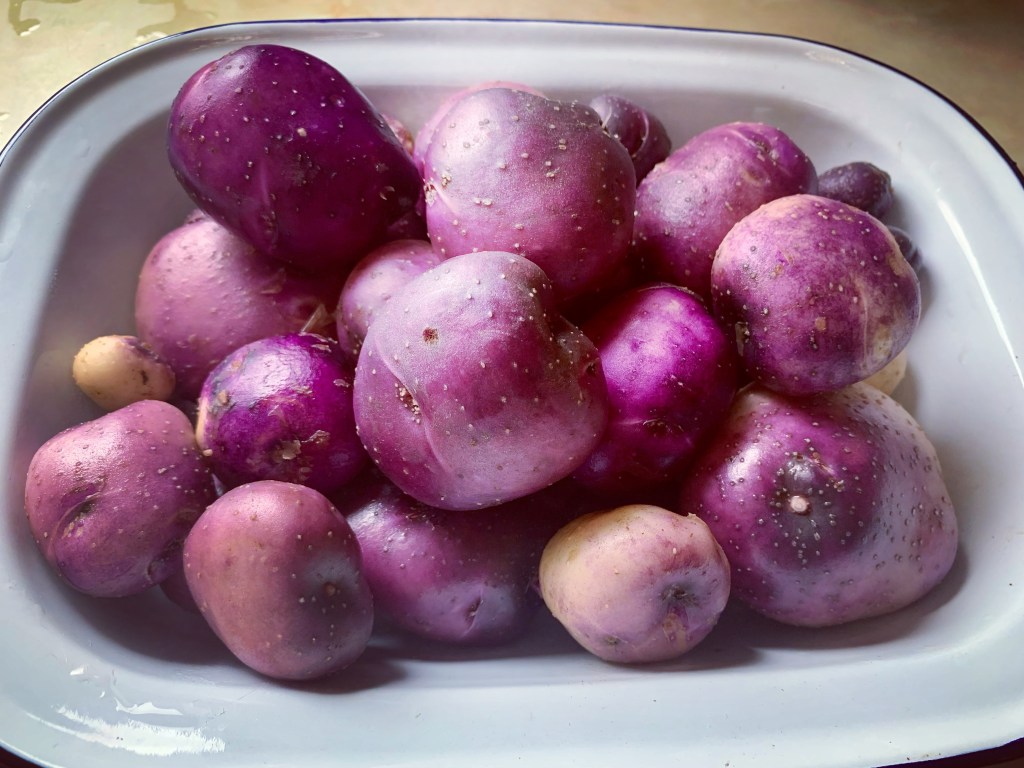
I planted Edzell Blue and Casablanca varieties from Scottish seed potatoes and Red Rooster from a bag of sprouted supermarket potatoes. The supermarket ones outperformed the specialist ones by a reasonable margin for a second year!
The first of the carrots are ready now, and I’m going to sow more. They’re sweet and very flavoursome.
The sweetcorn experiment is progressing! We have flowers and silks on a few of the plants, so I’ve been hand pollinating with the hope that we manage to get a few cobs at least.
All in all, not bad for a low-effort croft nurtured using organic principles and no-dig beds, in this weather and whilst not at my best due to illness. No pesticides, no inorganic fertilisers, no chemicals. I love that we can pick produce straight from the plant. The soil is fertile and giving, and we will continue to develop the beds next year with windbreaks and deer protection.
It seems strange but I can already detect the first wisps of autumn drifting in from the edges. The leaves on the ancient horse chestnut at the end of the lane are starting to turn russet. The seed heads on the long croft grasses are ripe and heavy. The season feels about to turn.
July is underway and with it comes the first of the proper harvests from the croft.
The polycrub really has been a game changer and we’ve managed to grow cucumbers and lettuce enough for all of our salads and more to spare for neighbours and friends. This in combination with the produce from the raised beds has meant a wide variety of foods can be grown throughout an extended season.
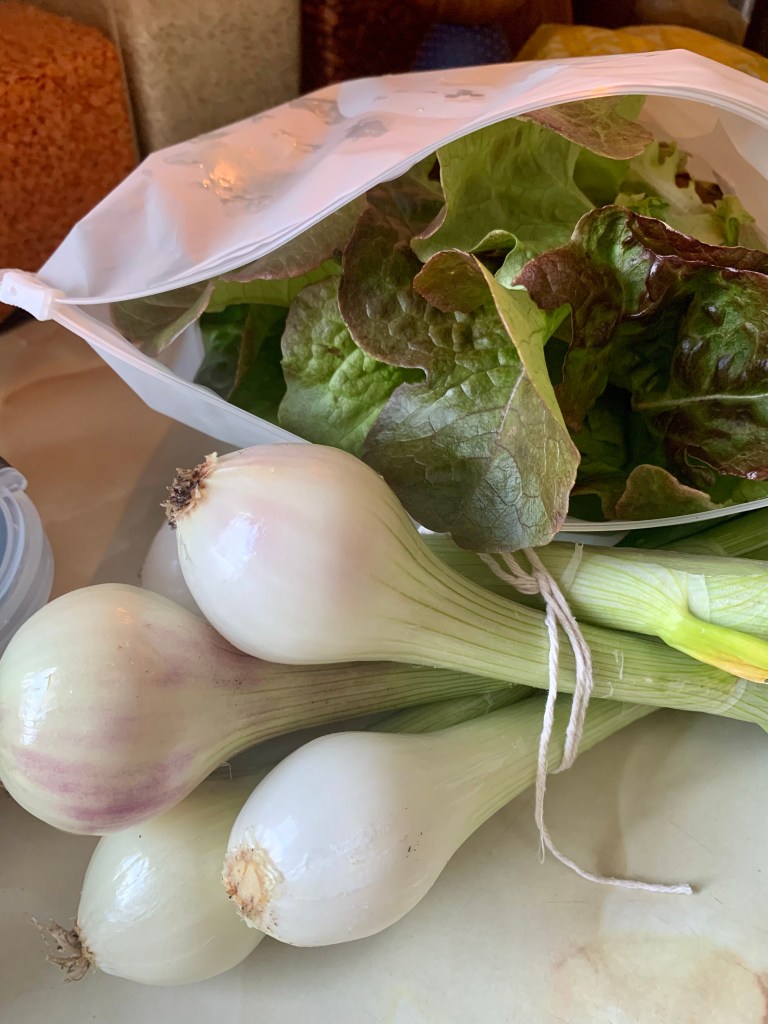
Lettuce and young onions
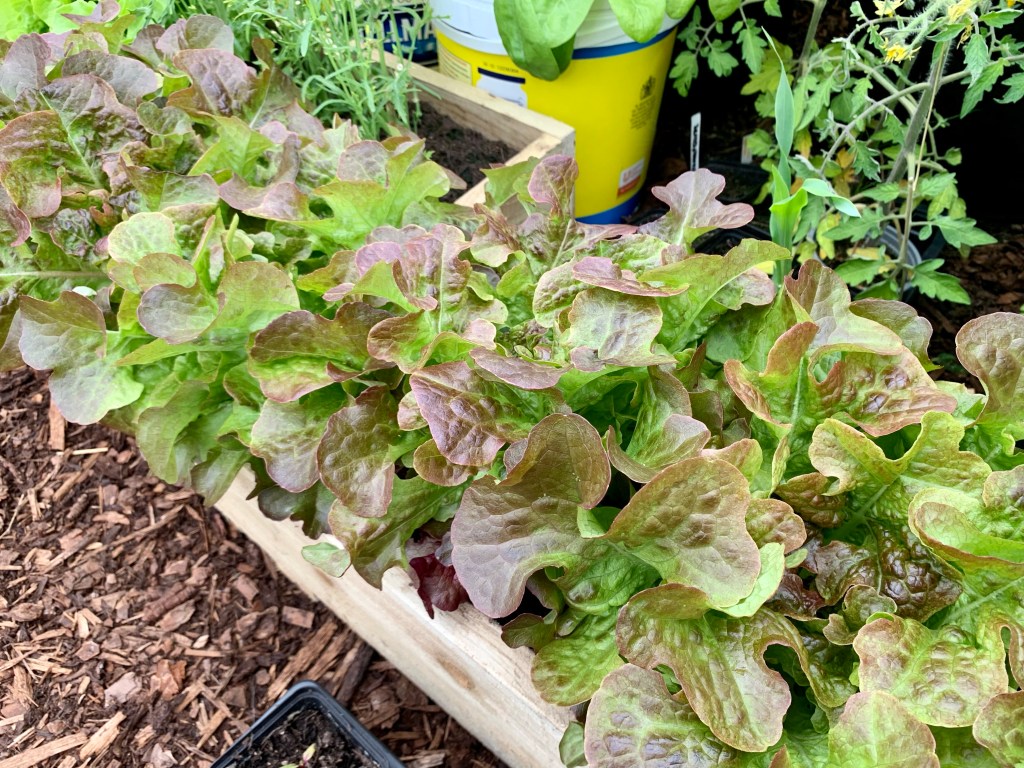
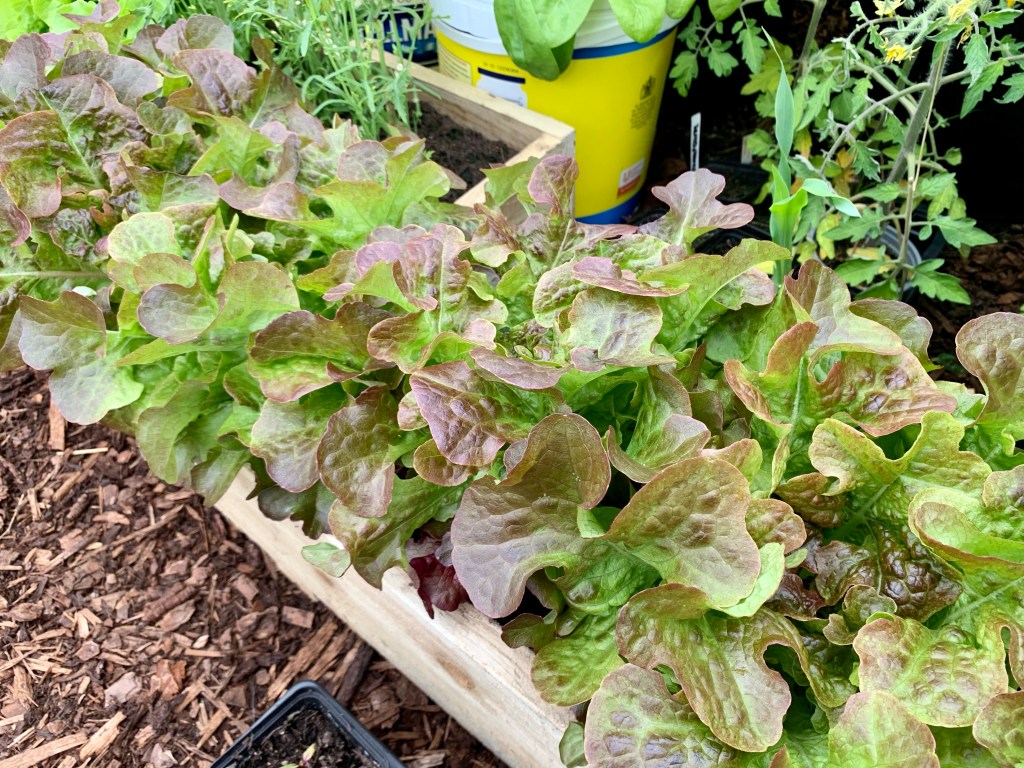
The most successful lettuce has been a butterhead, which we’ve been cropping as a cut and come again lettuce. We’re also growing romaine. All the mizunas and rocket grew well initially, but then bolted within weeks and became straggly. I don’t like eating the mustards and mizuna because of the spiky texture of their leaves so I won’t bother with these next year, and will just plant more lettuce.
Butterhead lettuce
The onions were supposed to be red onion varieties, but aren’t more than vaguely pink. They sent up flower shoots so most of them have been lifted before they soften.
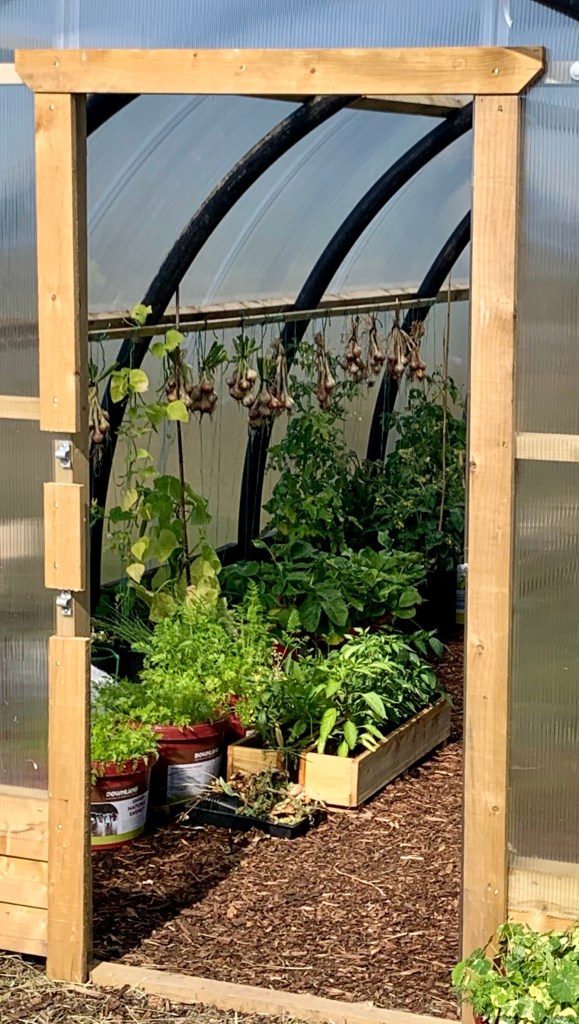
They’re small, but sweet. We’re using them in salads and cooking now and I have them drying in bunches ready for use later in the season.
Drying onions
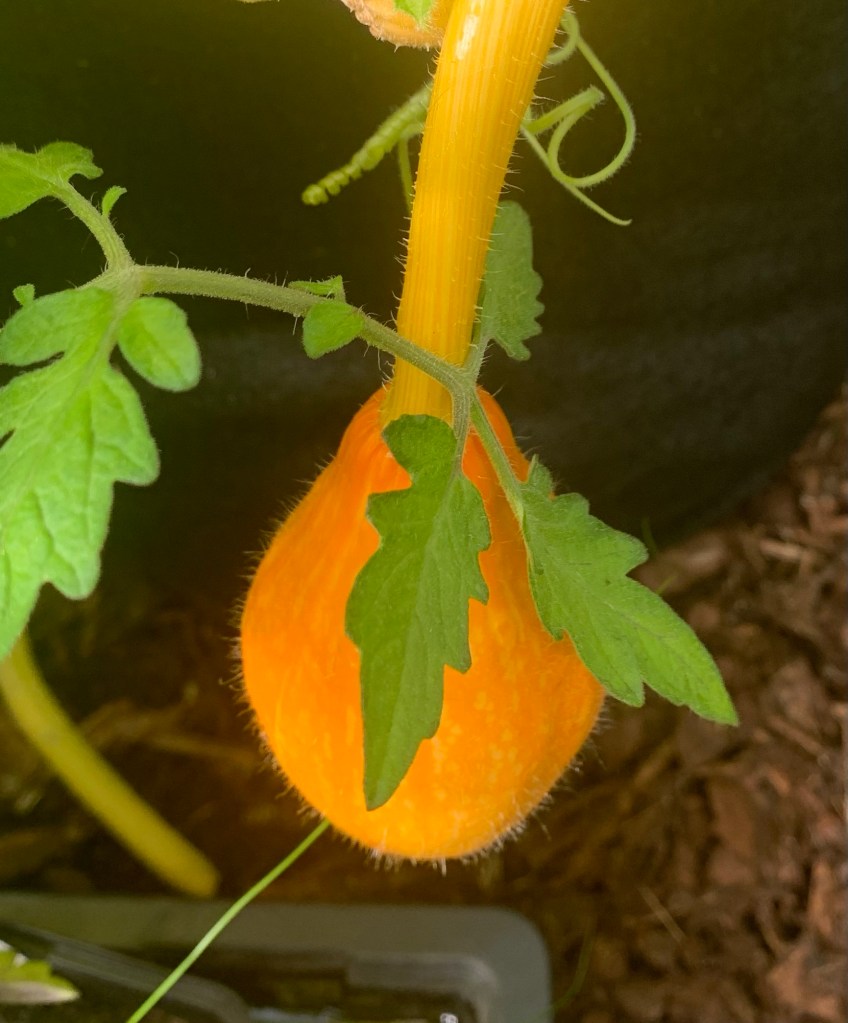
The red kuri squash has a few young fruits on it, which I’m very excited about. Early days, but I’m hopeful that we’ll have a few to harvest in late summer. The French squash hasn’t shown any sign of fruiting yet.
Baby squash hiding behind a tomato leaf
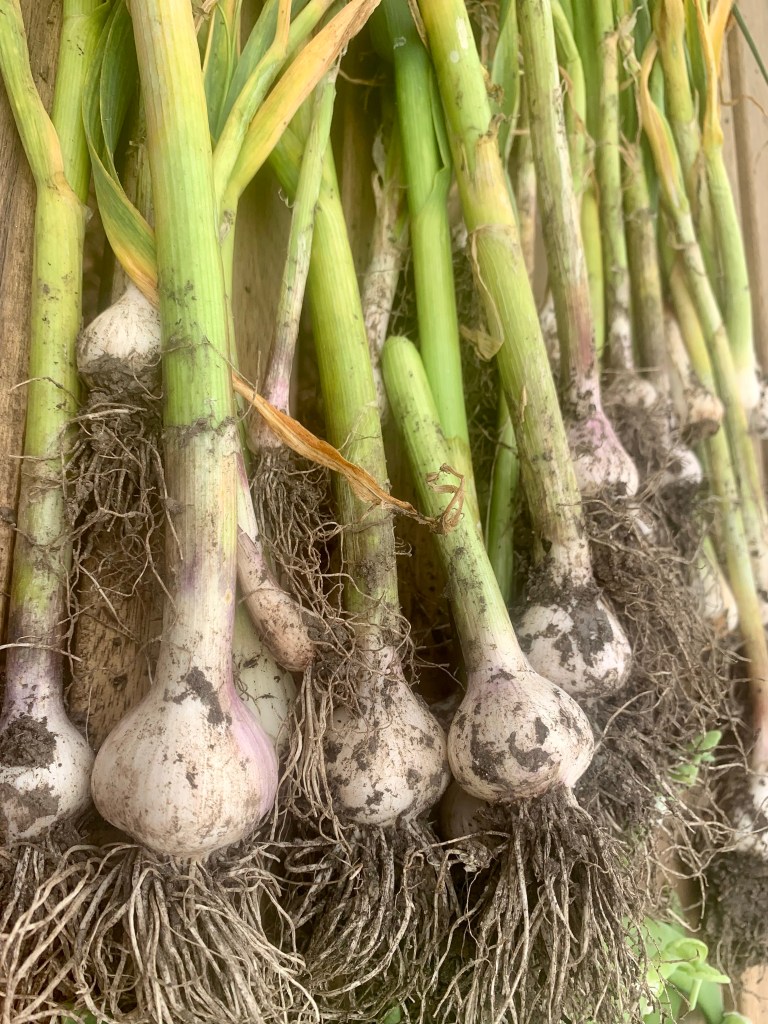
The garlic was a bit of a disappointment. Sown last October I had high hopes for bigger heads this year, but they’re still small. I’ll use them in stews and trays of roasted vegetables, so despite their lack of size they won’t be wasted.
Wimpy garlic
The potatoes are also much slower than last year. We’ve just harvested some Edzell Blue and Casablanca varieties. Great taste, but not hugely prolific. We’ll hold off for a while for the main crop variety.
Edzell Blue potatoes
The kale is growing well after the deer ate all of my perennial kales from the beds last winter. I grew more Uncle Bert’s kale and red Russian kale from seed and it’s coming up nicely. I’ve also sown purple sprouting broccoli into the beds recently, so between them that should give us a reasonable winter crop.
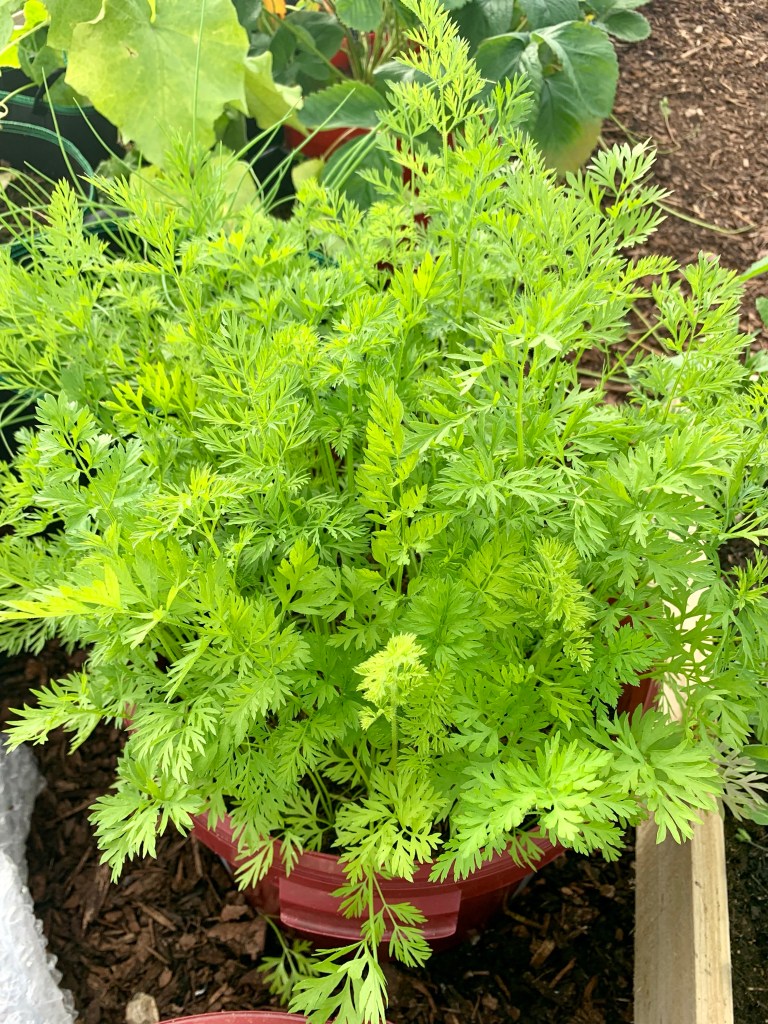
The carrots were grown in large seed lick tubs this year as an experiment. Three varieties, all French heritage types, growing well, albeit slowly. The first of these should be ready in a few weeks time.
Carrots
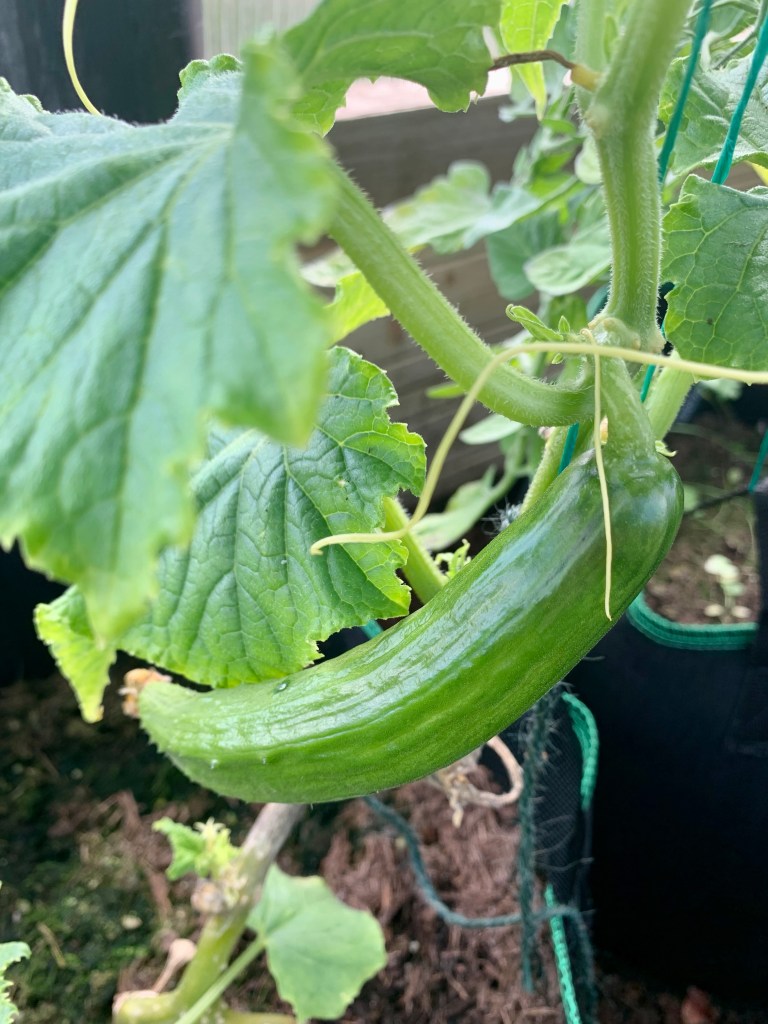
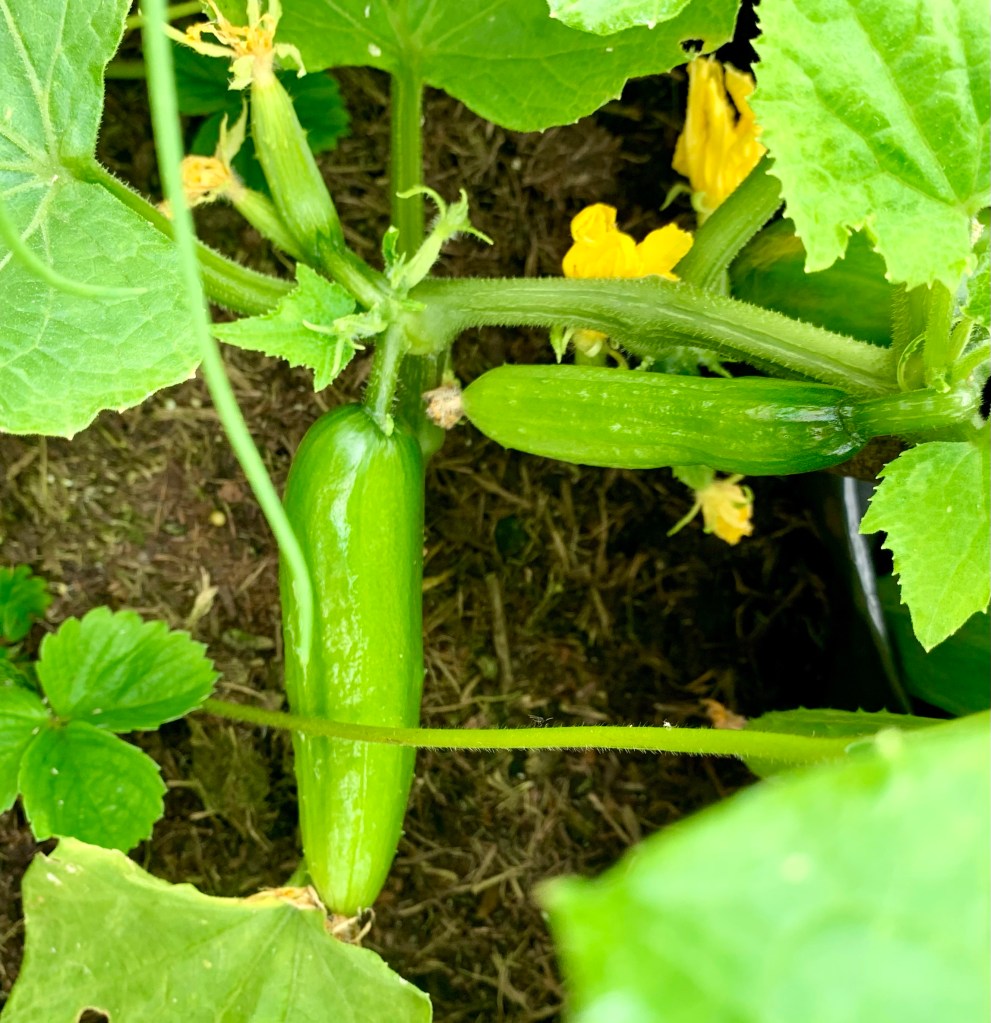
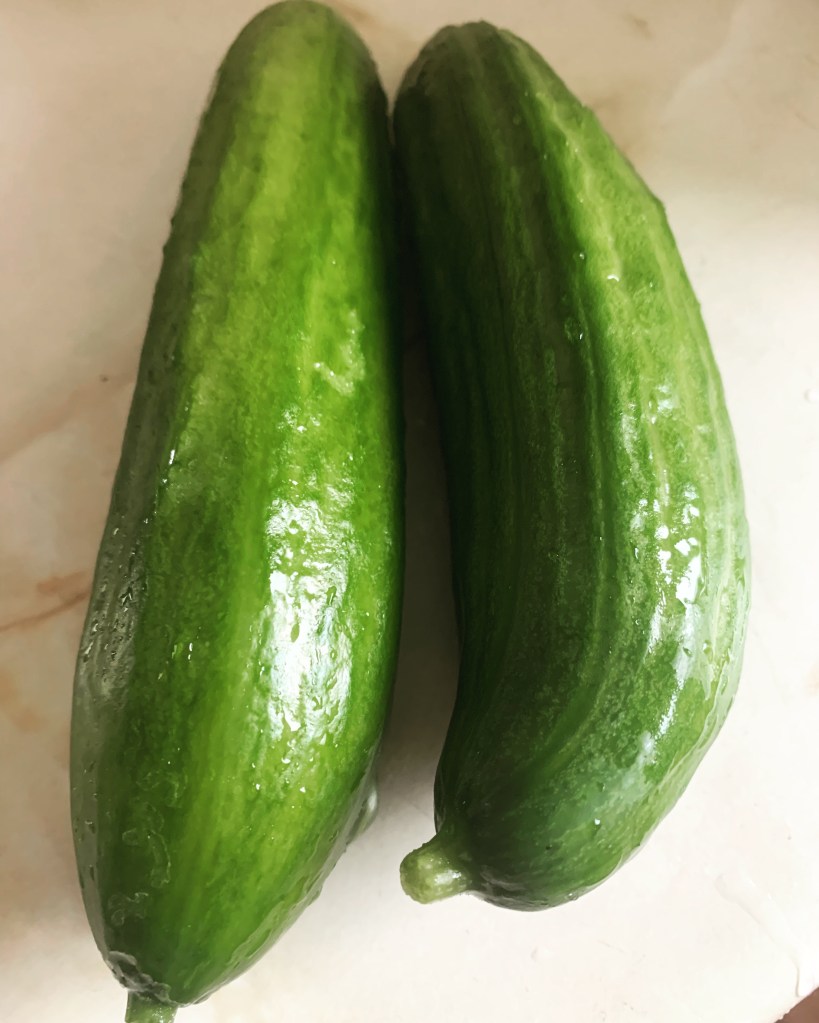
The cucumbers had a very faltering start due to the cold temperatures of late spring. A number rotted and wilted beyond salvation, but the three plants that did survive are fruiting well and have produced about six cucumbers ready for eating so far. There’s no trace of bitterness to their taste either, which is great.
Baby cucumber
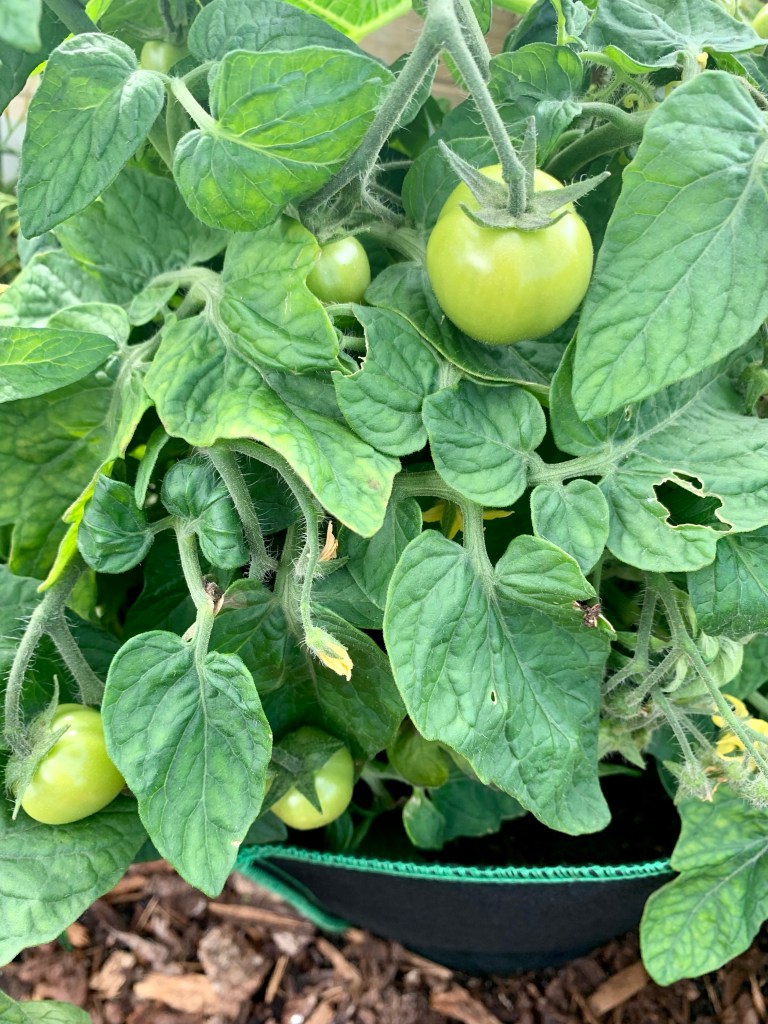
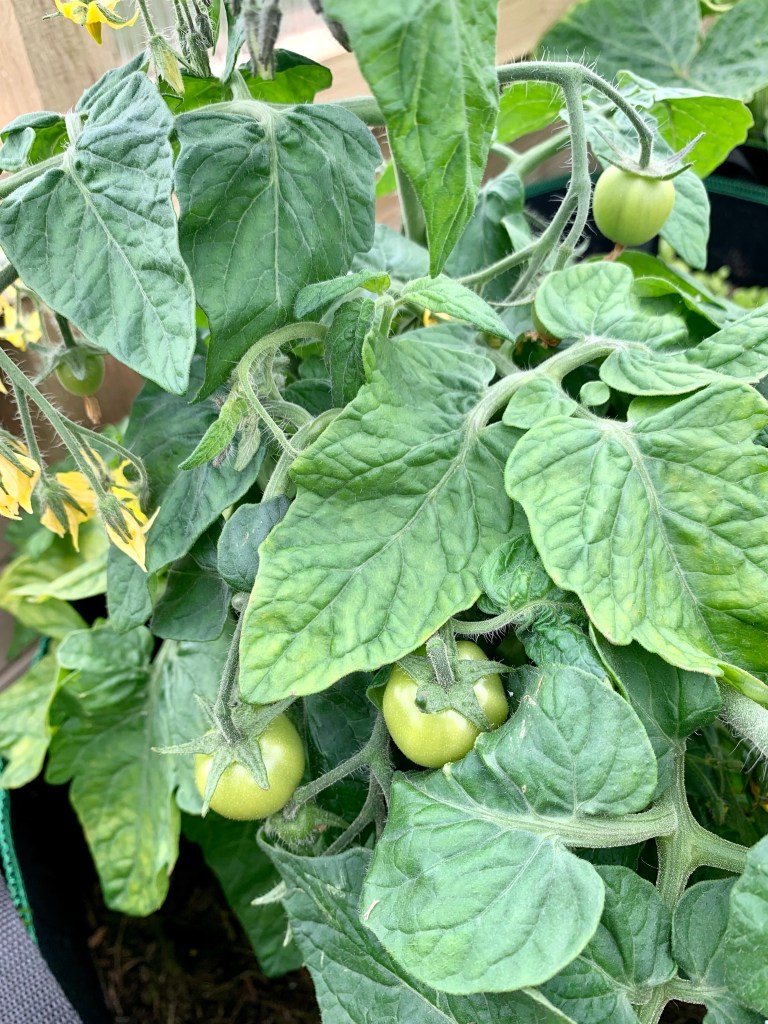
The tomatoes are starting to set fruit, again later than most due to our cold, late start. It will be interesting to see whether we can get them to ripen in time. The big Russian bush varieties are pruned and tall with not much evidence of fruit yet. The dwarf bushy varieties, which don’t get pruned, are happily fruiting away with no fuss.
Dwarf tomato plants doing their thing
The courgettes – I only planted two plants so that we weren’t overrun if they grew – have started fruiting, although the fruit is yellow rather than green, which is a total surprise. We’ve already had a handful of courgettes from them, and looking at the flowers there will be many more to come.
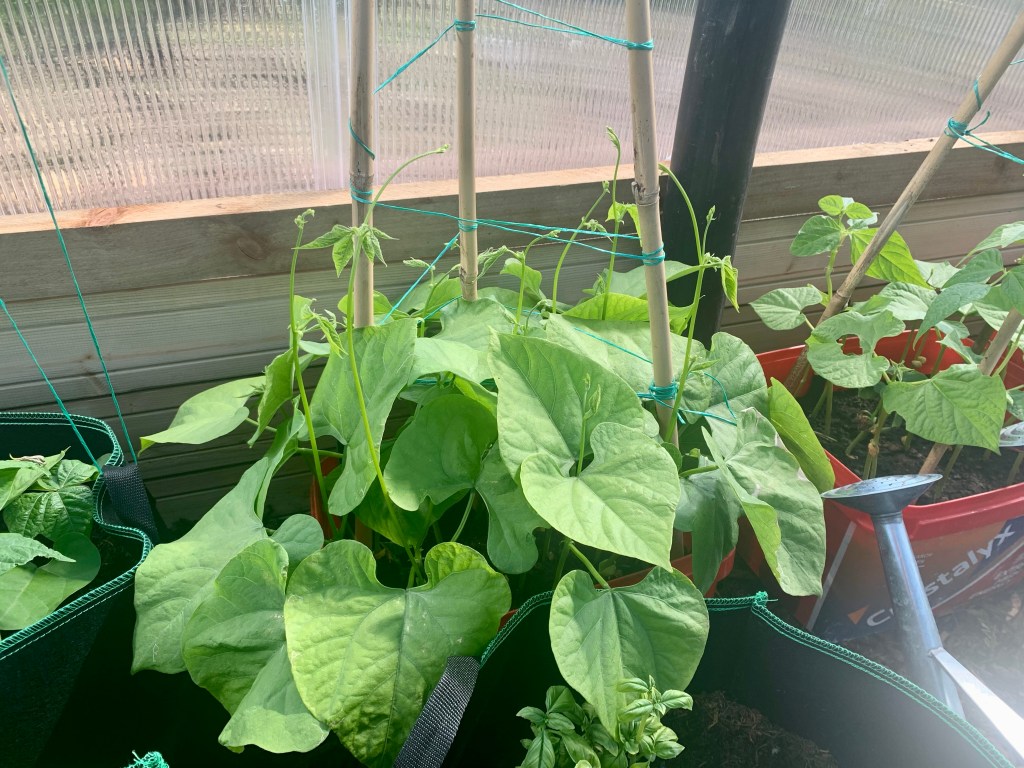
The beans have struggled. The borlotti beans are doing the best out of all the varieties and are starting to flower now, so I’m hopeful for a few fresh beans from them.
The corn is about four feet heigh although no sign of flowers or fruits yet.
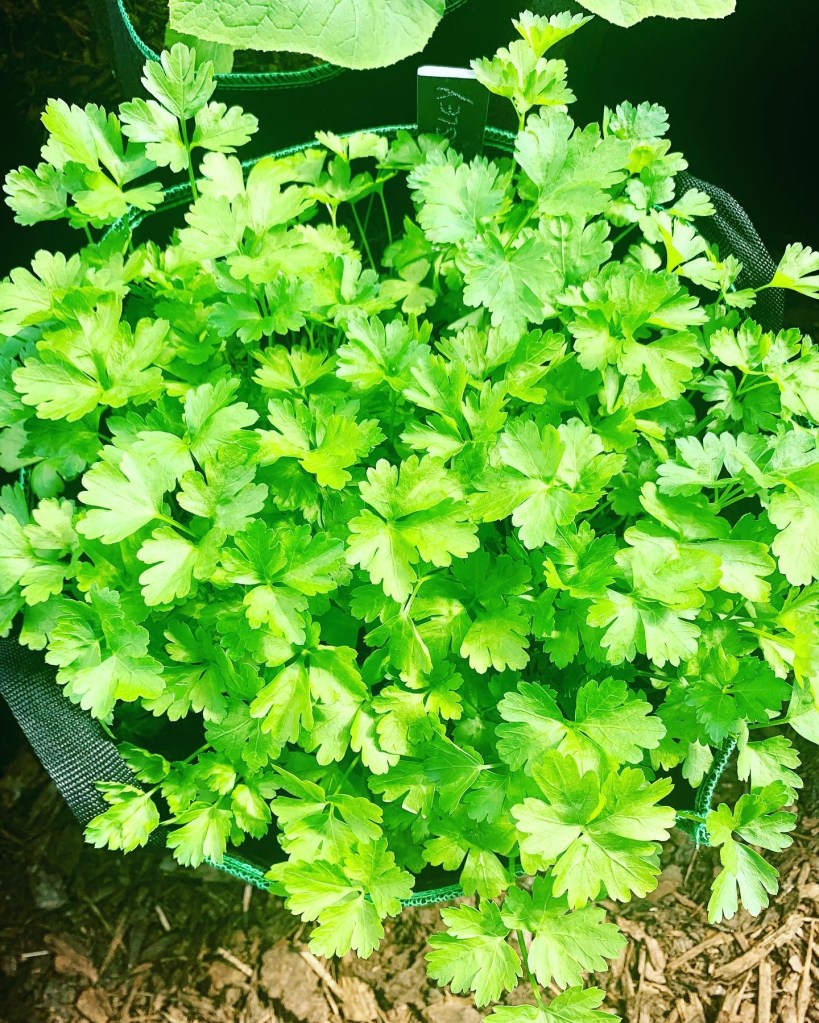
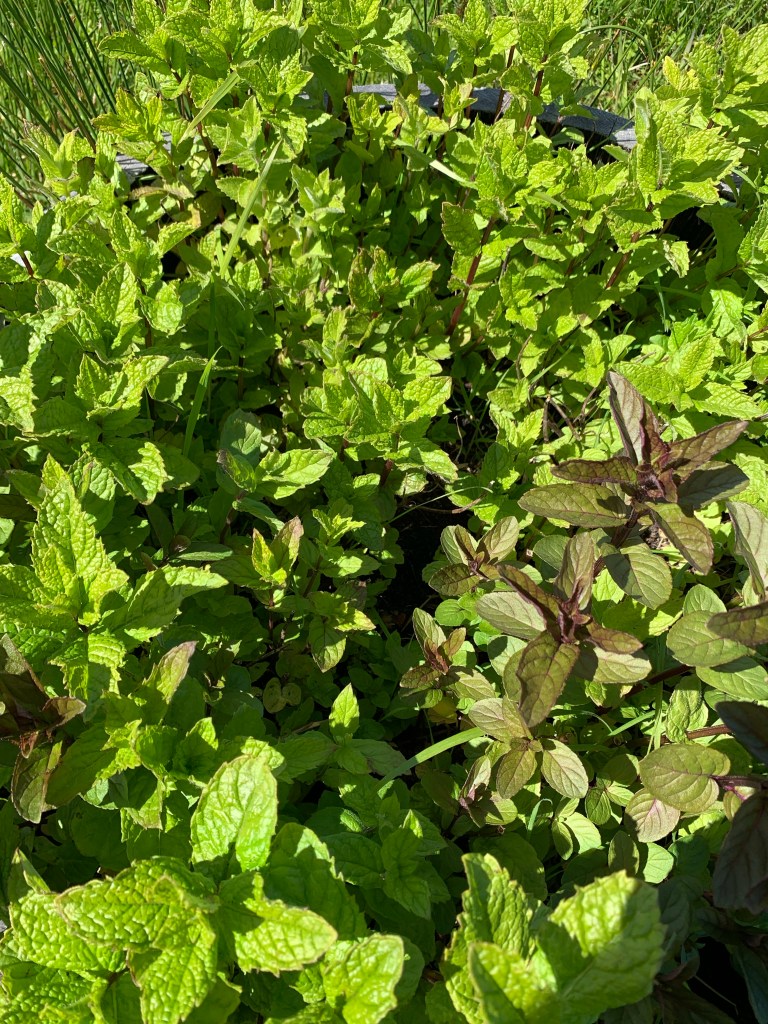
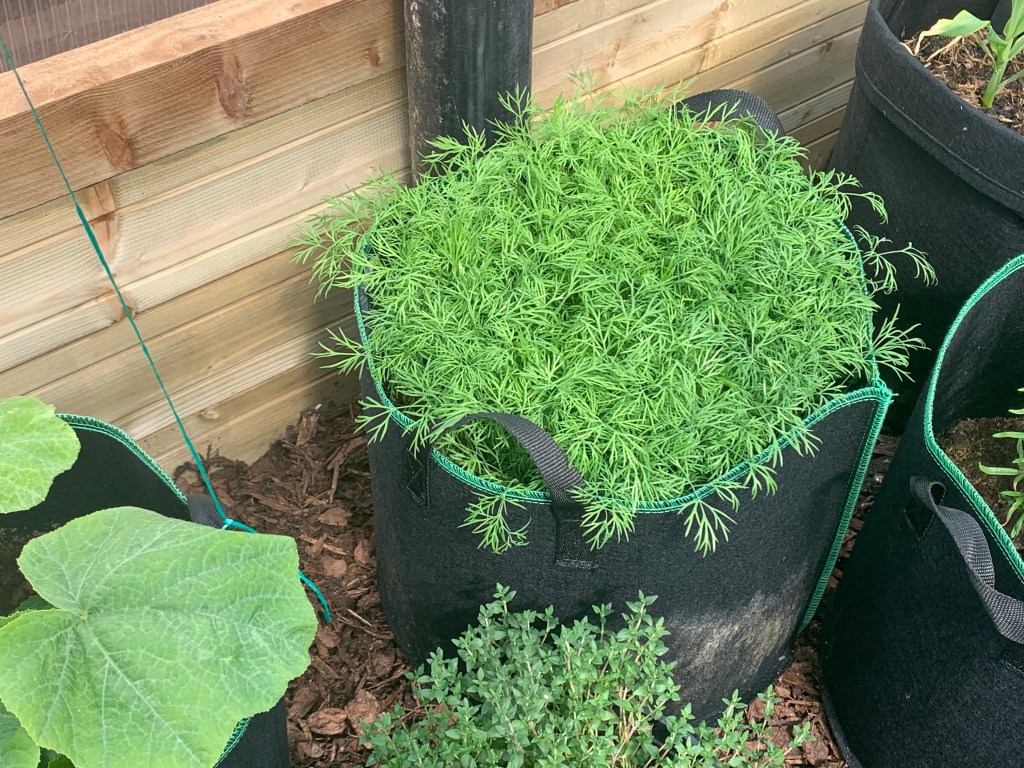
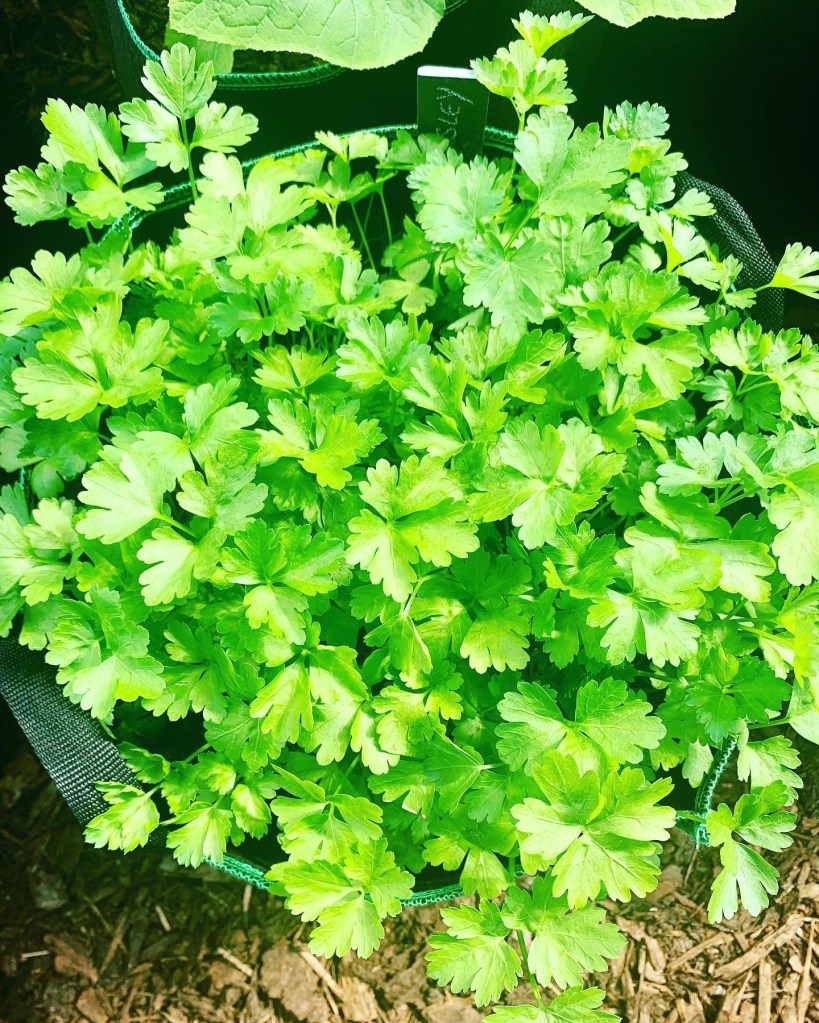
The herbs have gone mad – the tubs of parsley and coriander have gone crazy and we’ve been eating them for months, the dill the same and I’ve left some to go to seed for collection. The chives, lemon balm, rosemary, lemon verbena and mint are all growing well.
All in all, I’m happy with our first months of growing with the polycrub so far. It’s hard to believe that it’s only been here since mid April. I’ve learned a lot, and when we set up proper grow beds in there next year I’ll feel confident about what to plant out.
Now to start sowing the winter seeds! The year is turning already.
We have had an incredibly wet couple of months recently, and as I look ahead at the weather forecast for the next week, I see no respite. It really doesn’t feel like summer.
No sun, just back-to-back clouds and rain for the week to come. I’m clutching my mug of coffee and peering out through the rain-smeared caravan windows as I write.
Baby cucumbers at last
Luckily the polycrub remains largely unaffected by the rain. Everything seems to be growing nicely in there, although the lack of warmth and sunshine means that my tomatoes and courgettes are being very slow to set fruit. There are lots of flowers, but only a few tiny fruits so far, despite feeding and shaking to help pollination. More patience is needed as well as more sunshine!
Baby tomatoes
We have youngest stepson staying with us at the moment. I say youngest, he’s 21 😊. Despite being a child of the city, a very definite metro-being, he’s been quite taken by the rituals of watering, pruning, planting and harvesting in the polycrub and has been helping me with this.
Which is a really good thing as it’s a busy time of the year in there and I’m still pretty limited in what I can do since the operation, with no lifting or standing for too long.
Lettuce
He pricked out baby beetroot into pots yesterday and I showed him how to take excess foliage off the tomato plants to redirect energy into the setting fruits. He’s also been building plant stakes to support the trailing plants.
Sitting in there with his music on enjoying the now rather jungle-like environment of climbing greenery, it’s been nice to see him without his nose in his phone or laptop for a bit enjoying the outdoors. Well indoors really, I guess. A polycrub is a sort of halfway house, isn’t it…😊
Who knows, maybe we have another generation of growers in the making…
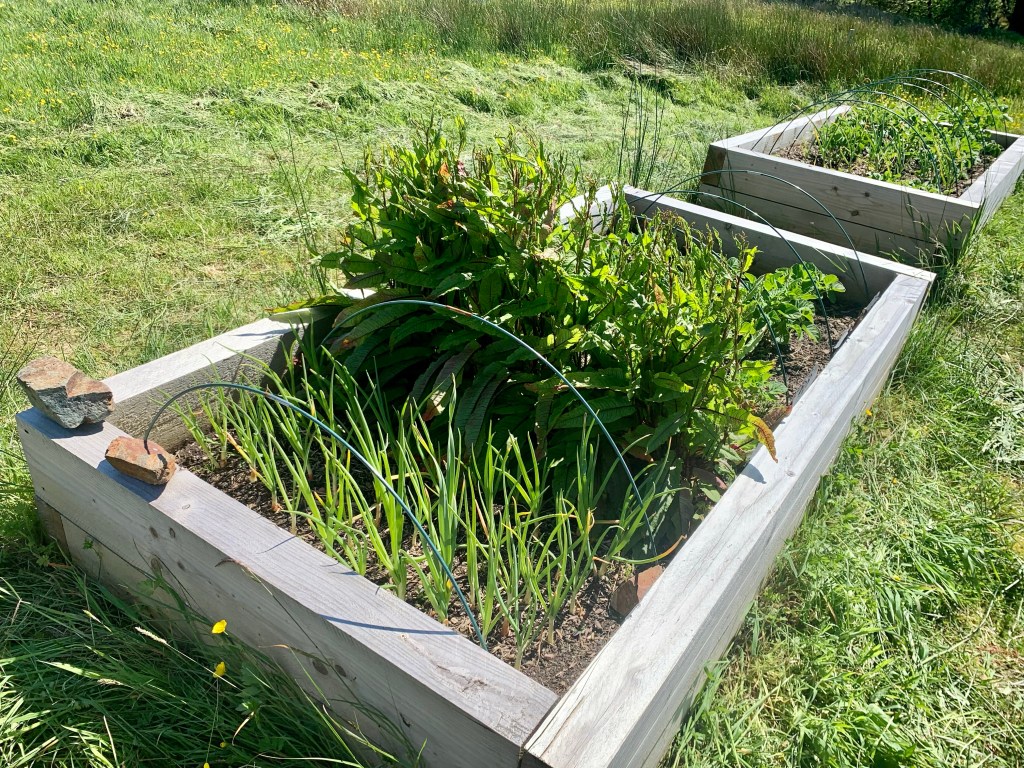
It’s amazing how quickly things grow at this time of the year. In the few weeks since I last posted about plant progress, the croft beds have filled up and are now bursting with foliage from the maturing potatoes, onions, garlic and kale.
Raised beds with sorrel in centre
The red veined sorrel planted last year was the only thing that the deer didn’t eat over winter, and in the last four weeks it’s shot up and is throwing out flower stems. We’ll keep the seed and cut it right back soon.
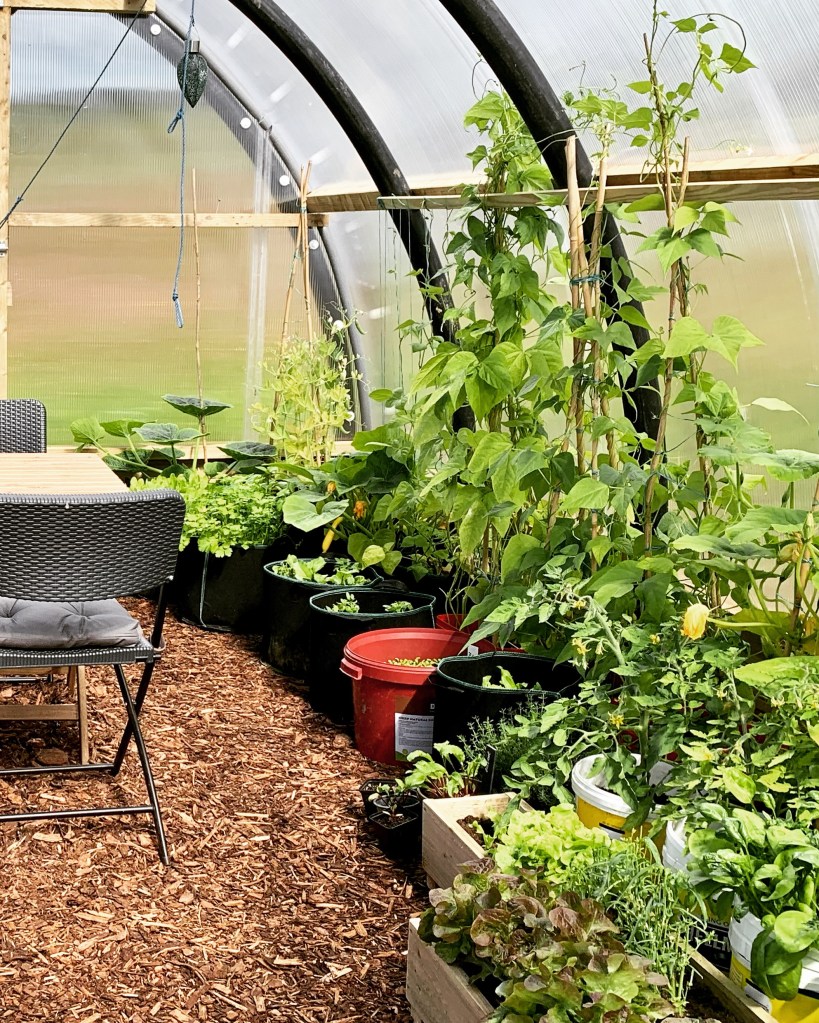
Mint going crazy Polycrub filling up
The polycrub plants are growing even faster. The tomatoes have flowers on them and the squashes, courgettes, beans and sweetcorn have all grown hugely.
Borlotti beans
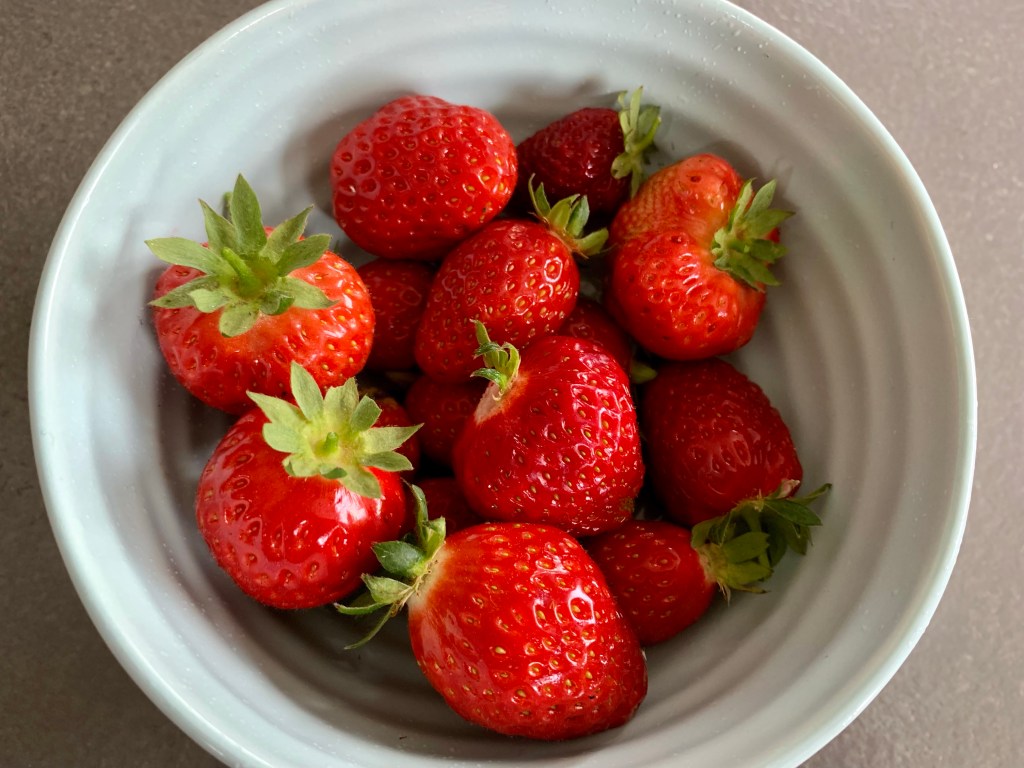
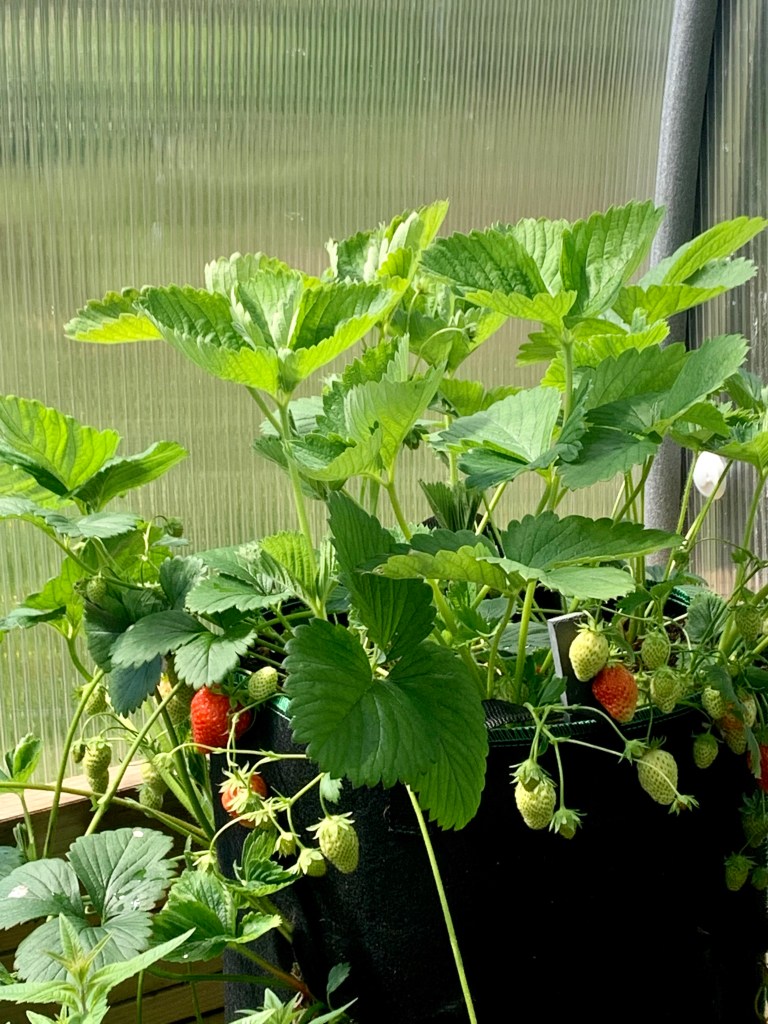
We’re already cropping strawberries from the three tubs of strawberry plants that we have. It’s just a small bowl each day, but they’re sweet and delicious.
Breakfast bowl of strawberry pickings
We have plans next year to increase strawberry production and as the plants are already sending out runners we should be able to propagate many more plants before next spring. We’ll install a couple of runs of drain piping to hold them above the raised beds.
StrawberriesHerbage (mammoth dill)
The days are long now. Sunrise is at about 4.30 am and sunset around 10.30pm, with the plants responding to the long days with rapid growth. The ravens set up a cacophony of noise at dawn to herald the start of day (thanks lads) and one of us potters over to open the polycrub some hours later once coffee has kicked in.
More herbage (parsley)
Soon we will start harvesting. We’re already cropping seed-grown parsley, coriander, basil and dill, as well as lettuce, but the potatoes and garlic won’t be long now. Then courgettes, spring onions, peas and beans. I’m already sowing purple sprouting broccoli, kale and pak choi to succession plant in the spaces that they will leave, and tomatoes, cucumbers, squash and corn won’t be far behind.
The polycrub is my happy place. It’s warm and sheltered and smells faintly of greenage and soil and the spiciness of growing leaves.
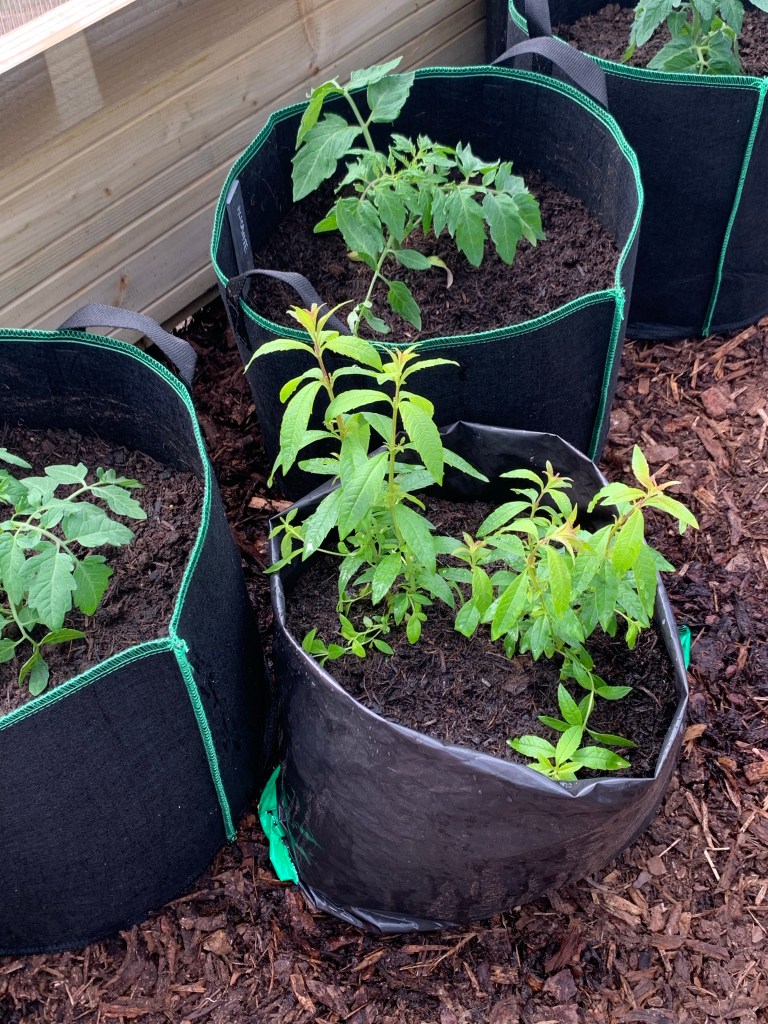
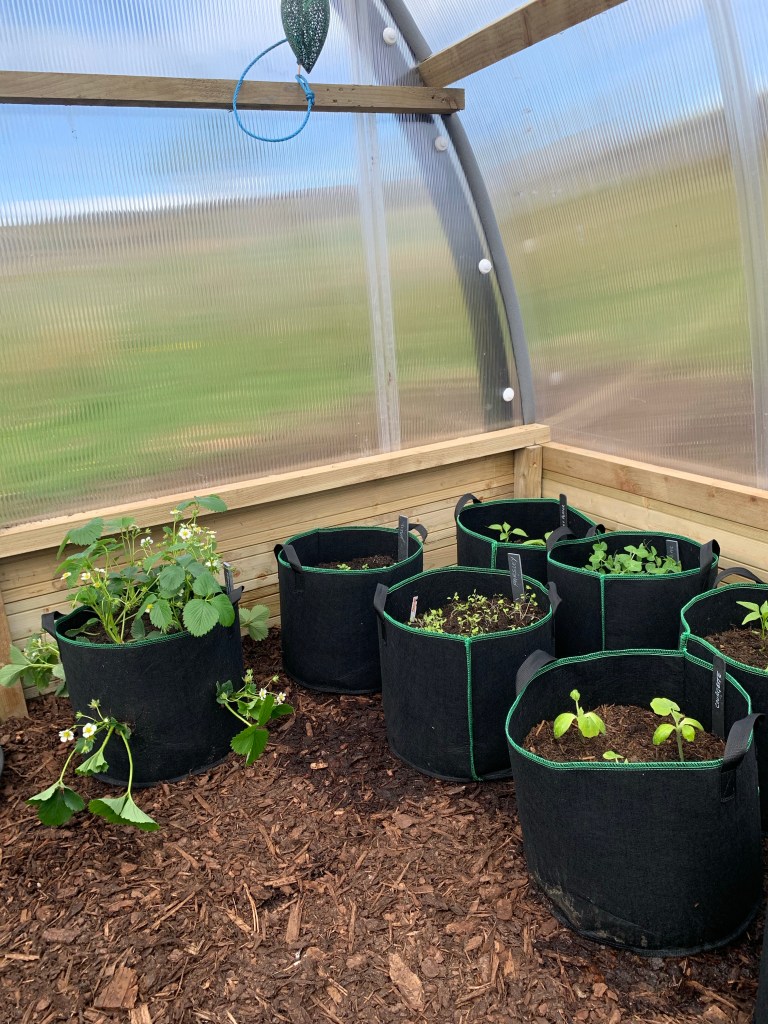
I’ve started the polycrub off with growing in canvas containers. We won’t have time to build and fill beds in there until next spring, and there isn’t much depth of soil beneath it before you hit the impenetrable seam of shale and lewissian gneiss.
I figured it was the best way of getting productive and a harvest this year.
Canvas grow bags and a repurposed compost bag!
They’re not expensive, a few pounds each, but when you’re using as many as I am it soon mounts up. So I put out a call via a couple of local friends for any unwanted large containers.
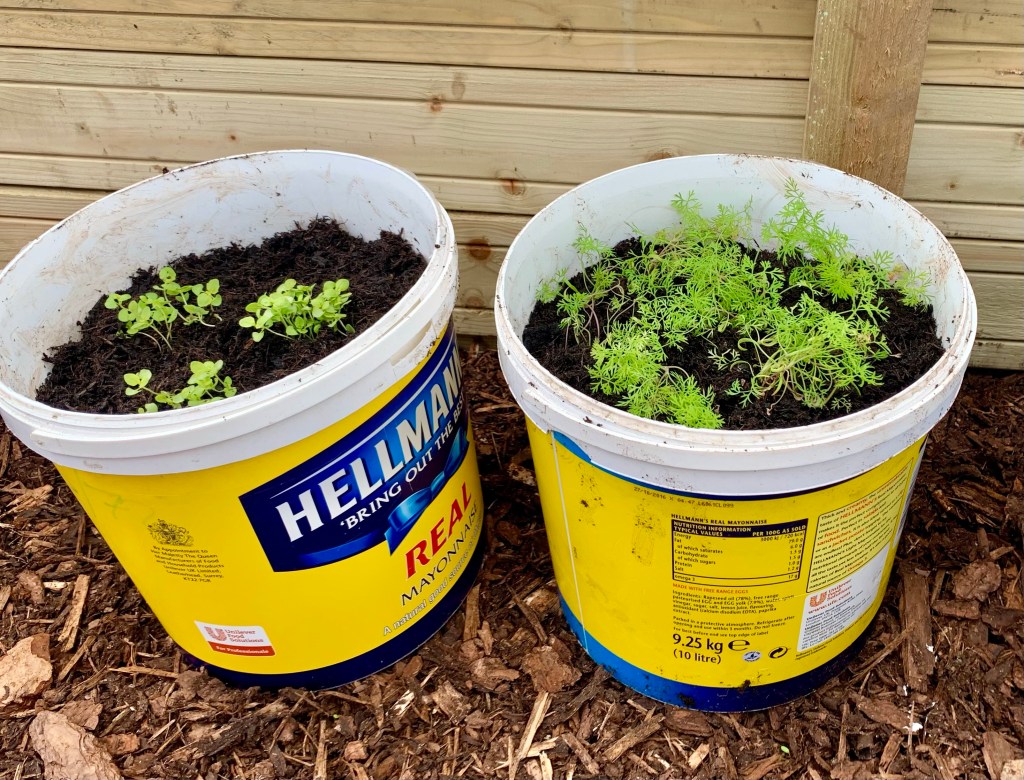
Friends at the newly established Coffee Bothy in Broadford offered up a dozen or more catering mayo tubs. A perfect size for herbs and smaller plants!
Old mayo tubs
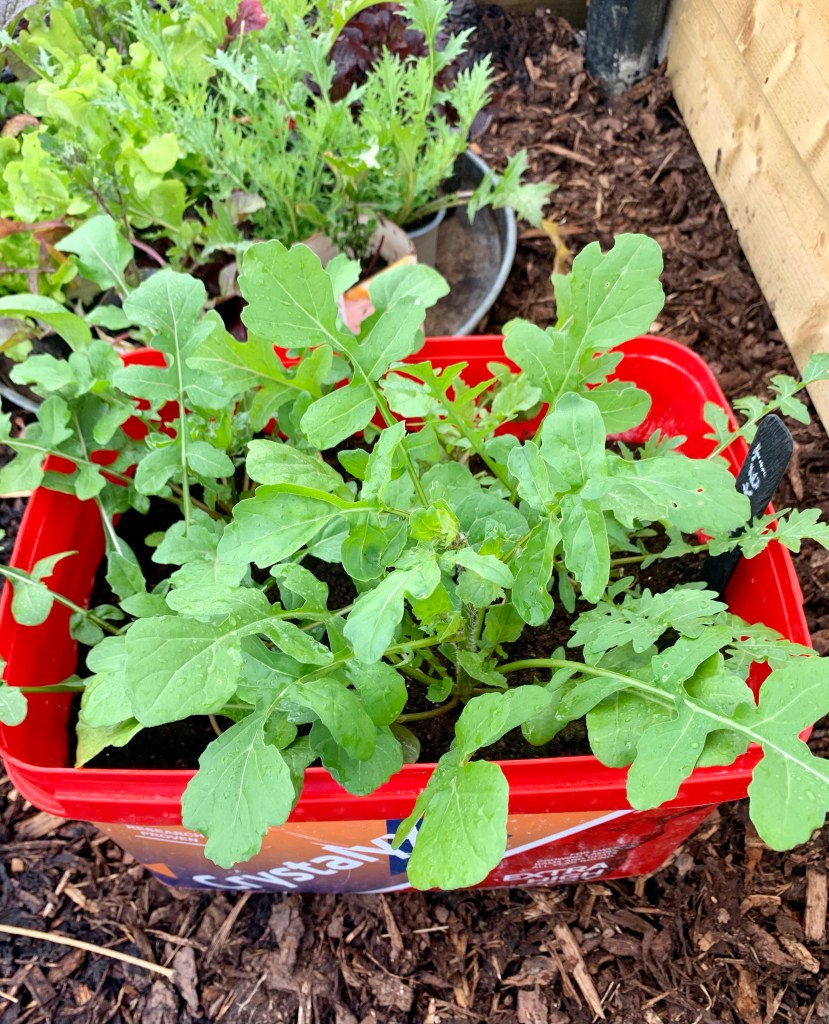
A couple of kind local crofters kept back their sheep lick tubs for me. They hold about 30 litres of soil or compost each so are deep enough for beans, potatoes or cucumbers to grow in.
Sheep lick tubs potted up with rocket
We drilled drainage holes in them and I have been busy planting them up for the last few days. If it holds soil, it gets filled with seedlings! It’s best not to stand too still around here 😊.
This is such a busy season for planting. I feel that I’m running slightly late with things this year but it’s been so cold that the seedlings that I started early have been very slow to grow.
Polycrub filling up
It’s always a balance here between waiting for the temperature to get warm enough but not leaving it so late that there isn’t enough season left for plants to mature.





 Ravencroft Skye