Skye Legends

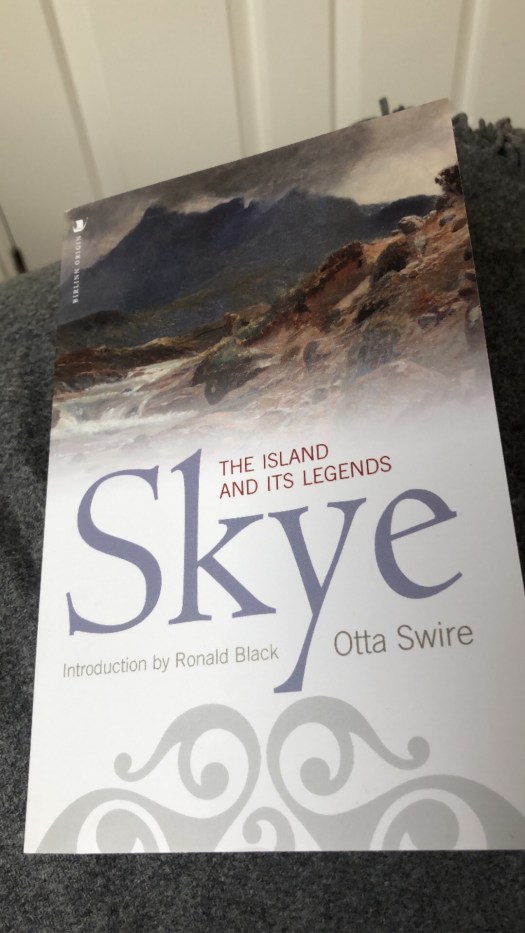
I’ve been reading this wonderful little book over the last weekend, in between sorting out cupboards and packing for the island. I have to confess to more tea and reading than actual packing…

It was written in 1952 by a lady called Otta Swire who loved the island and who collected its folktales as she travelled.

It does a complete circuit of the island, stretching out into each winged peninsula and recording the tales and legends heard in each village. Some of them are Celtic, stretching back into prehistory, some Nordic, some medieval ;- all fascinating.

It’s a fabulously rich source of the most amazing stories, and for those that don’t know the island well, a superb introduction to the differences between the areas. It’s true that the nature, feel and landscape of each of the peninsulas of Skye are all very different, and Otta Swire captures this uniqueness beautifully.

I laughed out loud and ended up recounting several of them to husband at various points over the weekend, always a good sign that I’m enjoying a book.

For me personally it’s important to know something of both the history and the folklore of the area that you live in, and Skye is deeply steeped in both. I think that learning the local lore binds you more closely to the land, gifting you the insight and the experiences that shaped those that lived before you.

Who knew for example that a local lochan was once said to host a magical water horse, that a bay less than a mile away from the croft sports the name “The Bay of the Forsaken Ones” or that the legend surrounding Castle Dunscaith includes the tragic tale of a wife who killed and fed her children to her cruel husband then threw herself to her death onto the rocks from a castle window?

Black cats feature heavily in the local folklore, as do blue men, kilted warriors, strange beasts such as water horses and the walrus….

It’s all part of the magic of this incredible place – dark, brooding, mysterious, sometimes grim, and very close to faery and the otherworld.

Perfect for dark evenings sitting around the fire and tale-telling over a glass or two of the local Talisker.

The best seat by the fire is always reserved for the Story Teller.
Curbing instincts

Knowing that we’ll soon be moving into the static, which has a tiny kitchen with very little storage space, means that I’m having to curb my tendency to stash food for emergencies such as the next zombie invasion or pandemic.

The current Covid-19 situation has only reinforced what I recognise is deep-set behaviour to store for bad times.

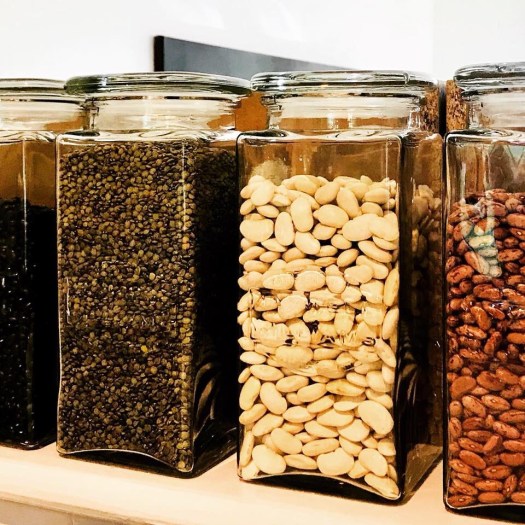
Every time I see a 10kg sack of basmati rice or puy lentils on sale I have to physically restrain myself from buying them. The instinct to stock up is strong, but there’s no logic in more dried goods sitting in storage with the furniture for six months whilst we complete the build.

There simply isn’t anywhere to put them.

I grit my teeth and tell myself that there will be the chance to fully stack that pantry once it’s built and ready to take supplies. And not a moment sooner.

I think I’m on the spectrum somewhere (aren’t we all in some way, I guess?) but it gives me great satisfaction to list what the pantry will eventually hold. I haven’t confessed to husband yet, but I’ve got LISTS of proposed purchases.

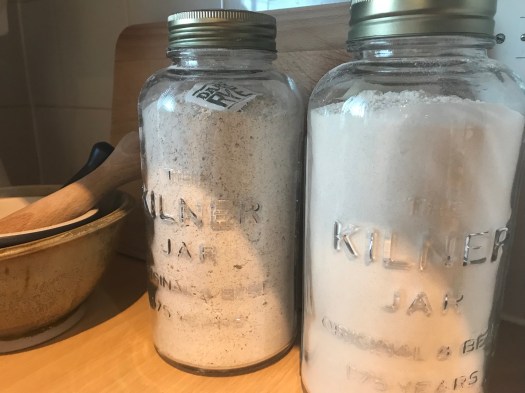
I’ve been looking at labelling systems, storage jars and boxes, and what shelving we’ll need…😂

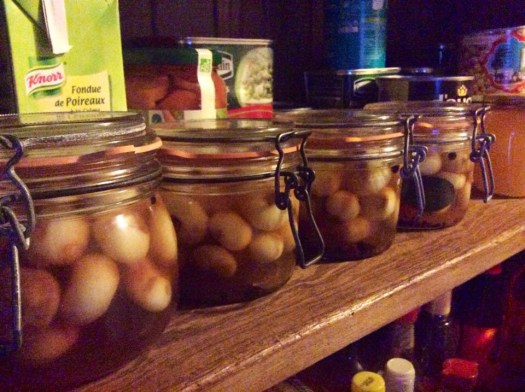
It maybe the smallest room in the house, but I’m planning to make every inch of the storage work, and I can’t wait to add homemade jams, pickles and cordials to the stash next summer to see us through those long, dark, wet Scottish winters.

The joy of posi joists

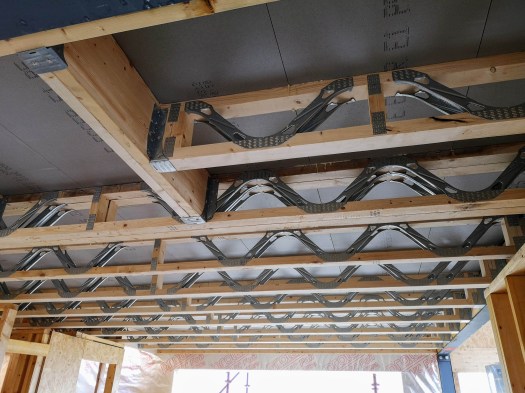
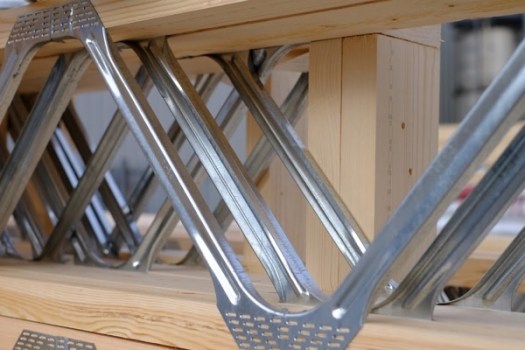
When the photos arrived last week from the site, one of the things that most struck me as a building novice was our joists.

I had never seen joists like this before. To be honest, I’d never given joists much thought. Thankfully our architects had!

A few minutes research online confirmed that these were web or posi joists, and that they’ve been around for a while.

Hugely strong with a steel web reinforcing the timber struts, they enable long spans of floor to be constructed without structural reinforcement such as load bearing walls, and their open nature allows easy installation of services, like MVHR.

MVHR (Mechanical Ventilation and Heat Recovery) systems are a very effective way to reduce the heat energy used in thermally efficient homes. We will be installing MVHR and these joists enable the ducts to be run through the construction very easily.

There is also less movement in these joists than with traditional timber, meaning more solidity to floors, less creaking and better sound insulation.

The more I read about these joists the more I realise that these were a great inclusion, and yet another element of the build that I’ve been quietly impressed with.

This may look like a traditional island house from the outside once it’s clad in larch and its roof has been slated, but its bones will be made up from the latest technologies in building innovation, making this a warm, strong, energy efficient construction which I hope will benefit us for many years to come.

The Weaving

When we started on this journey I wanted to somehow commemorate the move to the island and build of our forever home.

I wanted to find a medium that was unique and significant to us in some way. Both husband and I love art, and I especially love textiles, so we decided to combine these two loves into the idea of a weaving.

Personally, my emotional response to the island has always been to do with its light, colours and textures.

The ever changing skies over the island exhibit colours that range from deep, brooding greys to clear, intense blues.

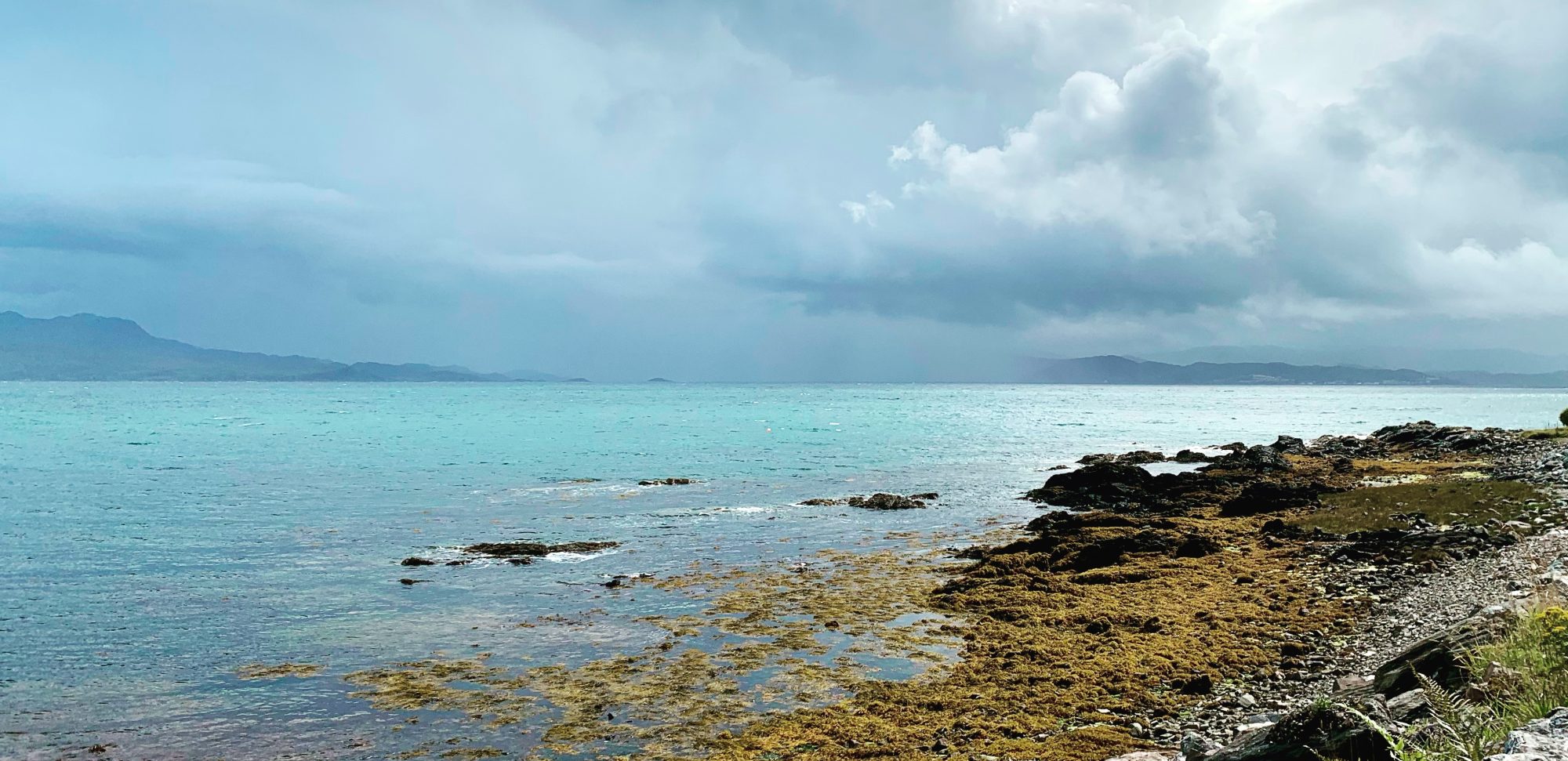
There is the translucent, steel-grey of the sea which changes to patches of iridescent aquamarine in the shallower waters.

And on the land, the textures of sand and pebbles on the local beaches and the ancient, speckled, rain-smoothed granite poking through the reeds on the croft.

I’ll create my own art in response to all of this one day, that’s something I’m quite sure of. I’m just not ready yet.

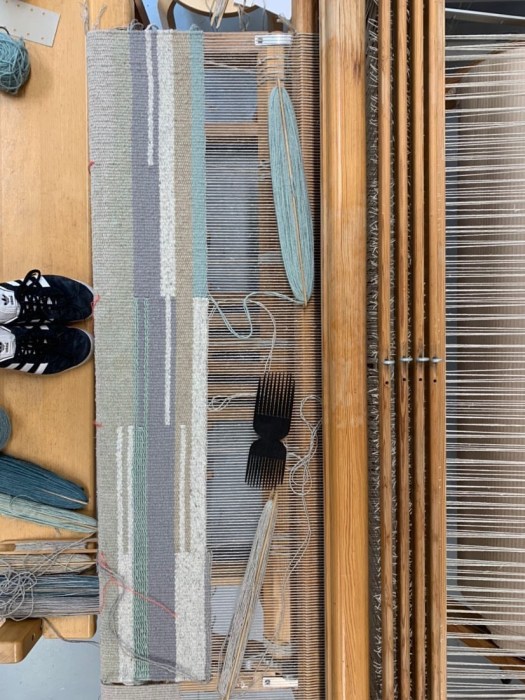
In the meantime, I’ve found a talented young weaver called Christy Balfour and I’ve commissioned her to weave us a piece for our new home.

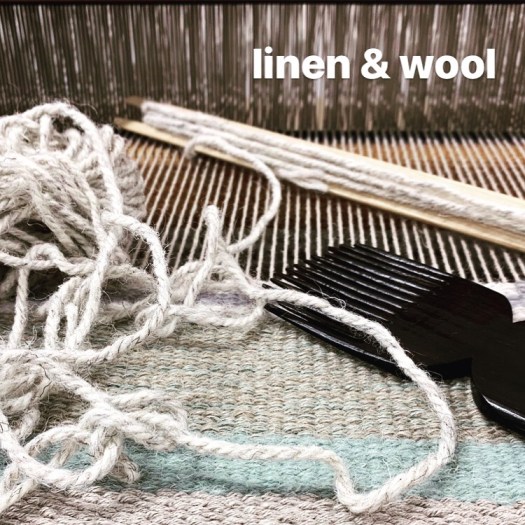
It’s in a mixture of different weight wools and linens, texturally varied and interesting and in washed-out greys, sables, greens and aquas – sky, croft and sea colours.

It’s Christy’s own design, and quite abstract. It’s being woven now and should be ready in a few more months.

It will be the first piece of art that we mount on the walls next year, and having seen the plans and the early samples above, I think it’s going to be amazing.

Young artists find it incredibly tough to live on the proceeds of their work so I’m so pleased that we’ve been able to do this, especially during lockdown when things must have been especially challenging for small businesses.

And we will have a piece of work that has been created in direct response to our feelings about the island.

Wild flower meadow

We’ve only been able to visit the croft a couple of times since we bought it, and those visits were usually during autumn or winter.

The main thing that we’d noticed on the land – apart from the absence of trees – was the dominance of reeds. They grew in thick clumps all over the croft. The crofter next door used to graze his sheep on the land, and this kept what grass there was between the reed clumps closely cropped.

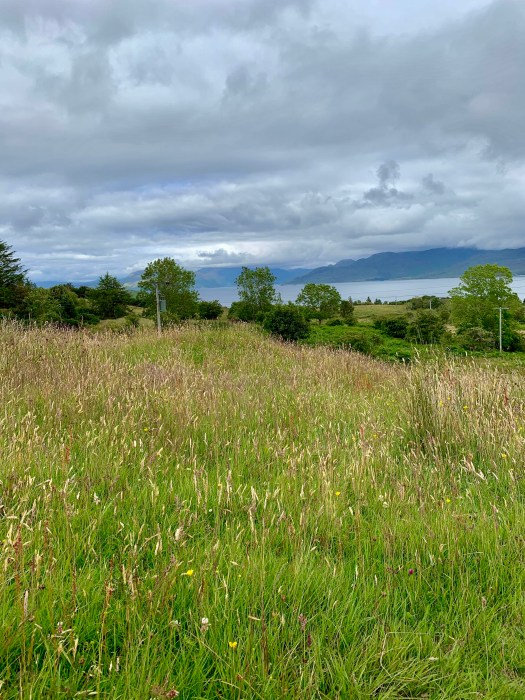
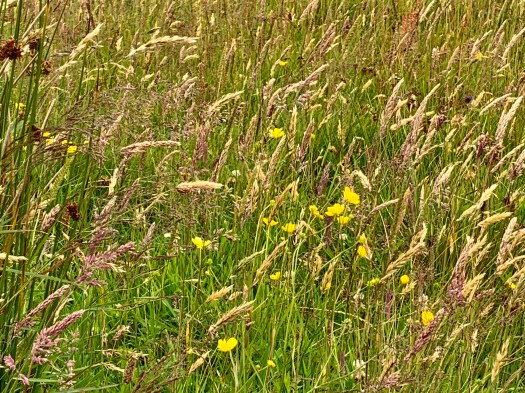
Our neighbours walked up onto the croft this afternoon whilst there were no builders on site, and took these pictures of the meadow below the house lying peacefully in the sunshine.

We were delighted to see that the grasses had regenerated and that there were wild flowers scattered through them. We haven’t seeded or done anything to this area – this is just one seasons regrowth now that the sheep are no longer on the land.

We can’t wait to see what else grows. The land has never been worked except for sheep grazing, and as such it’s completely organic and natural.

We’ll try as hard as possible not to disturb this habitat with our tree planting plans. The habitat that this provides to wildlife is invaluable, and to our eyes it’s beautiful.

Dribbles from the island

Updates dribble in slowly from the builders like the intermittent drip from a tap.

Not known as the most patient of people, I await them anxiously, counting the days and weeks since the last email. It’s tough being remote from a build project when it’s your very future going up one block at a time.

Updates do come though – not every week, and not always with accompanying photos, but progress is definitely being made.

I believe that the concrete has been poured onto the foundation slab and that the builders are ready to start erecting the SIP panels next week. They’ve advised that the panels normally take about three weeks to complete.

After that the roof slates go on, then the larch cladding for the walls. By the time we visit in September we’ll definitely have the semblance of a house to see, even if it’s just the exterior shell.

It’s going to be an emotional moment.

Taking Shape

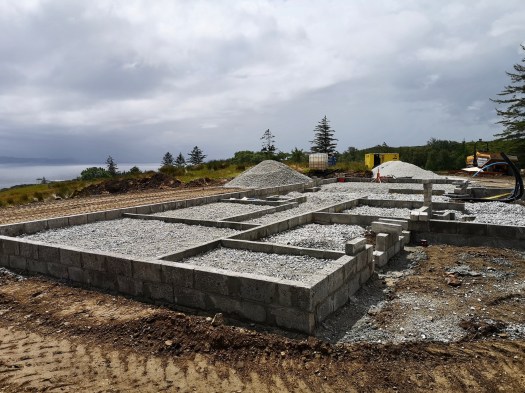
It’s taking shape, and the builders have been working hard to move this on whilst the weather holds.

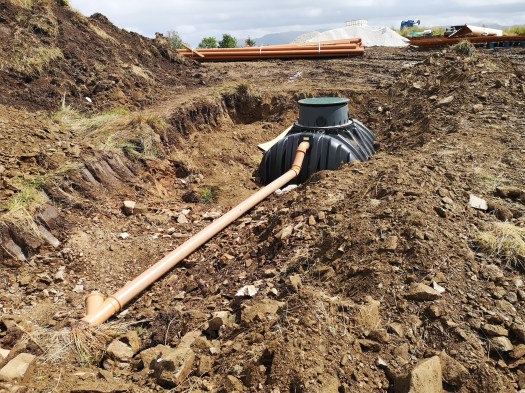
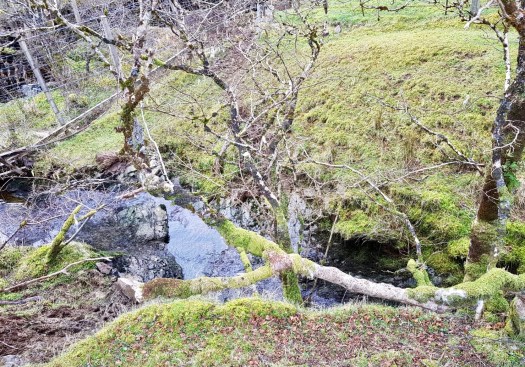
It looks as if the sewerage treatment plant is starting to go in, and the outlet pipe is being connected. This will discharge clean, treated water via an outfall into the burn at the back of the house.

Let’s hope that the water and electricity connections will be confirmed soon, as we won’t be able to progress beyond the summer without them.
It’s so good to see the house starting to emerge from the land. This is the first time that I’ve really been able to visualise it properly in it’s setting, and I think it’s going to sit well….

More progress, and the static

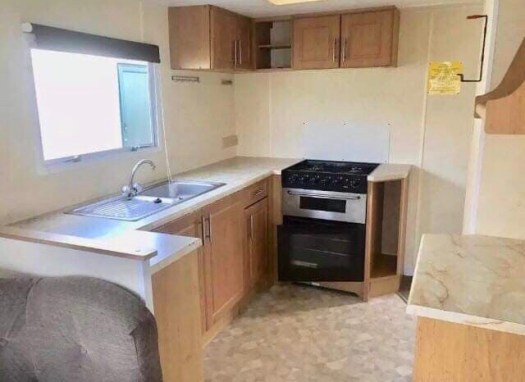
The kindness of strangers never ceases to amaze us. We’ve been offered a free static caravan by locals on the island to live in whilst we complete the build.

It’s old but fully functioning. It will need a lick of paint, a new boiler and replacement carpet in the main living area, but with all of that and transport costs it will still save us many thousands of pounds.

I’d been researching static caravans and not only are they pricey but the haulage costs can be massive. Due to their ten or twelve feet of width they need a police traffic escort, and so even bargains elsewhere in the U.K. would cost many thousands to transport to the island.

(This image was taken before two years of mud from their house build site was trodden in..😊 it looks much worse now…)

The couple that have offered it to us have been living in it themselves until recently as they completed their own self build, and can make it available from September, which is perfect timing for us. We’re so grateful.

We will be siting it close to the house itself so that connection to power and water will be easier.

The foundations are progressing at pace now, helped by the recent good weather.

This does mean that it will be perched in a somewhat exposed position on the top of the hill of the croft, and a local friend suggested that tethering the static to concrete footings with lorry straps might be prudent due to the winter gales on Skye. We’ve asked the builders to create tether points for us in the hard standing at the back of the house site so that we can do just that.

We don’t fancy tumbling down the hill like a corrugated tin dustball in a storm…

The track begins

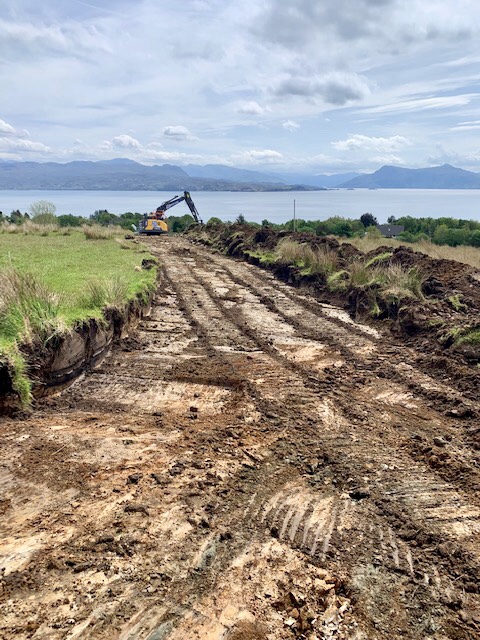
And so it begins. The builder has been sending us photos and videos of the emerging access track whilst it’s being excavated. Very exciting. It looks wide enough to be a motorway in this picture! Sadly building regs dictate that it has to be wide enough for a fire truck to get up to the house, so it does seem wide, but it’s the minimum width we can get away with…

As we suspected, the gradient is very steep in places. The builder has excavated a borrow pit on the croft for extra soil and rock for infill and will try and smooth out the most extreme parts of the slope, although it’s always going to be a steep climb up to the house.

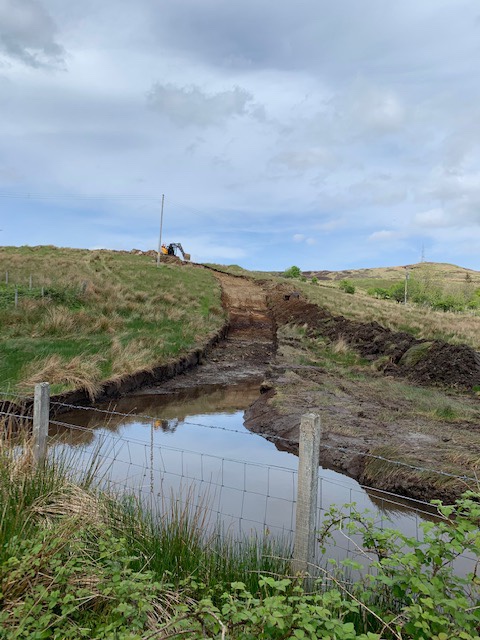
As we also suspected, the boggy bottom of the croft at the base of the hill is actually almost a lake once the soil has been removed. You can see the water level clearly in this photo, right where the entrance bellmouth will be connecting to the communal village road. The video from the digger shows this clearly too.

There will be drainage into both the culvert and back onto the land so that we can remove enough water to make the road viable, but also further along in the process we can perhaps dig a wildlife pond in this area. That plus willow and alder planting and we hope that it will dry out enough to be useable. If not, it’ll be a big natural wetland area, which I’m sure will do wonders for the croft’s natural diversity!

The builders seem to have managed to circumnavigate the two big granite outcrops at the top of the croft and run the road between them. Which is good. Rock blasting and removal is another expense that we are heartily glad not to incur on an already massively expensive road.

But it’s progress! We are so cheered to see this. At last, for the first time after all these months of planning, specification and permissions, it actually seems real.

Knitting through uncertainty

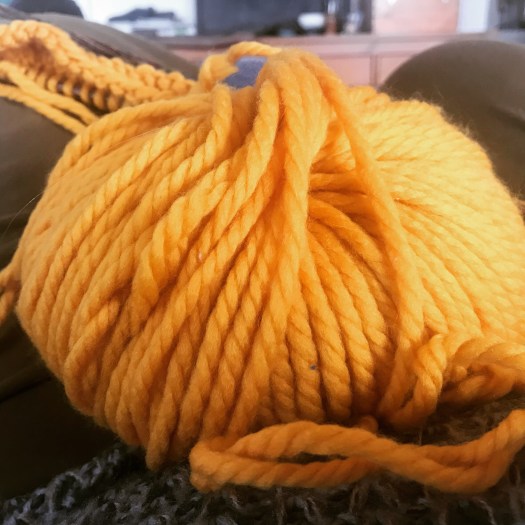
When the going gets tough, dig out your largest, brightest ball of yarn and get knitting!

With the whole world seemingly in meltdown, either quarantined in their homes or trapped in an endless loop of panic buying toilet roll, our house build problems seem to pale into insignificance.

I am recovering at home this week following a manipulation under anaesthetic on my replacement knee.

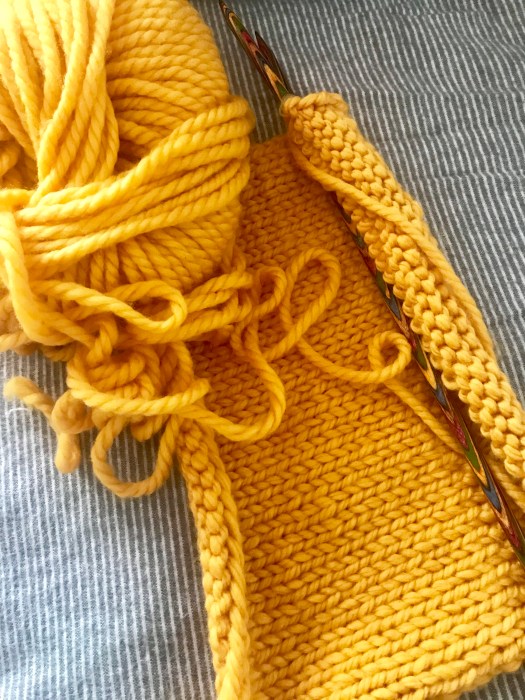
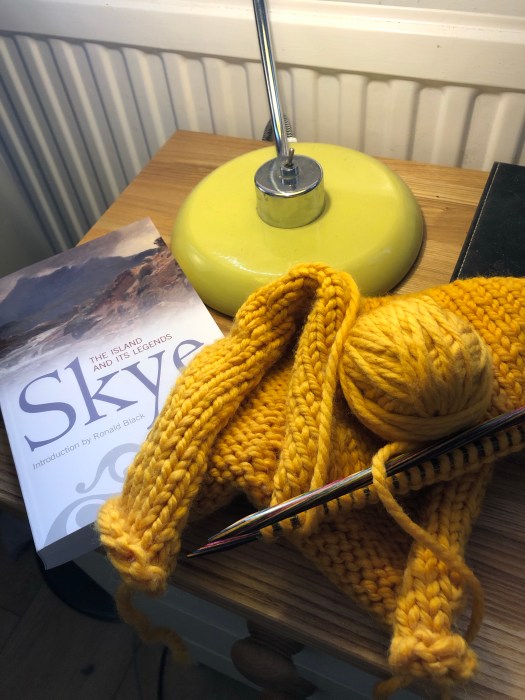
As such, whilst waiting to hear about revised costs and start dates for the house build which I am sure will be delayed even further, I am keeping my knee mobile with an exercise machine, dutifully swallowing my pain medication and knitting a very loud, very yellow scarf.

Coping mechanisms for the times, eh..