It’s a blustery, wet February evening here in London. We’re tucked up and relaxing after a heavy week, winding down and recalibrating for the weekend.
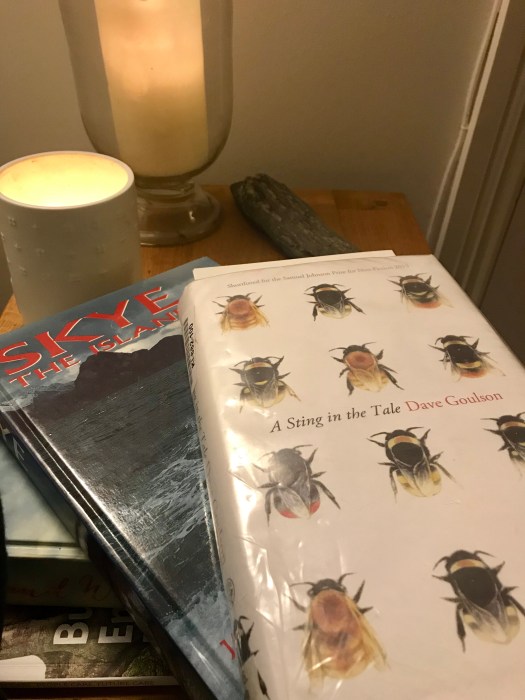
A weekend isn’t down time without something in the form of a book in my world, and on my reading list this weekend are three things that I’m looking forward to:
- The winter issue of Permaculture magazine
- Skye the Island by James Hunter
- A Sting in the Tale by Dave Goulson
Permaculture magazine is just there to top up the dream-pot with pictures of wildflower strewn farms, woodlands and hobbit homes built of driftwood and reclaimed windows. It keeps me inspired by what others have achieved in their desire to live sustainably. I doubt that we’ll ever live like some of the people featured in it, but it’s an inspiration!
Skye the Island is a wonderfully interesting book written by a historian who lives there. It is written without the usual romanticism and sentimentality about the island, and is a moving, evocative and hopeful text on the bitterness of the island clearances and the possibilities for the future. James Hunter is a lecturer at the University of the Highlands and Islands.
A Sting in the Tale is a book about bumblebees. Written by one of the UK’s most respected conservationists, whose passion for these fascinating insects shines through every page, it’s also a warning about the destruction of their populations and the potential dangers if we are to continue down this path.
All this material nurtures my desire to revitalise the land that we’ve bought and create an environment that is as rich, biologically diverse and as wild as we can keep it.
I can’t wait to get started.
 Ravencroft Skye
A book filled weekend sounds perfect to me..
Enjoy!
LikeLiked by 1 person
Thank you! I rarely get the time to read in big slugs of time, sadly, so it’s a stolen hour here and there around other things that need to be done
LikeLiked by 1 person
You will need a well stocked library for the “inside” days when all you want to do is curl up by the stove with a good book.
Tip n+1 – don’t skimp on the bookshelves try to insert them in every nook and cranny.
I would recommend Dave Goulson’s other books too, a highly respected scientist with the ability to write about entomology in a very attractive style.
LikeLiked by 1 person
Totally agree. Every cranny will be stacked… as they are at the moment! And thanks for the onward reading recommendation – he’s extremely readable as well as clearly hugely knowledgeable. I loved the anecdote about his childhood where he tried to dry some damp bees off by putting them on baking parchment on the cooker hob on low… baked bees! He was traumatised. ☺️
LikeLike
You came across my blog article that spoke of the Book the Sound of Sleat, An Artist’s Life, about the artist John Schueler. The book itself left me with a nihilistic but wonderful impression of Skye (yes I know it sounds contradictory!).
For your bookshelves I can recommend anything by Charlie Connelly but in particular: Attention All Shipping: A Journey Round the Shipping Forecast Connelly is very readable and this book is not only informative in places it made me laugh out loud. I had already painted a series called The Shipping Forecast when I’d come across the book but I so loved the book that I wrote to Charlie (writing to an author of a book was a first for me) and told him how much I enjoyed it and also about the paintings. Imagine my surprise when my son’s business partner mentioned to him he was reading this same book and that I was mentioned in the back of the edition he had.
LikeLiked by 1 person
Thank you Linda. I love receiving book recommendations. I will source a copy of both for my reading pile ☺️
LikeLike
J & D > Be patient : let the land slowly reveal its treasures. A specialist in bees visiting the island for Scottish Natural Heritage to do a study, came into our walled garden to buy a jar of jam or something like that to take home with him. He said that we’d got three species of bumble-bee, all rare, nesting in the gaps and crevices of the garden wall.
LikeLiked by 1 person
I will be. I know that the journey doesn’t really start at all until we’re living on the land. In the meantime all I can do is learn and read and plan as best as I can. I also know that the reality will never be as I expect, for good and bad.
That’s a wonderful story. Your garden must be an absolute utopia for bumblebees so far north with pollen, nectar and shelter.
LikeLike
Dave Goulson recounts a wonderful story of training MOD sniffer dogs to find bumblebee nests, and an expedition to Tiree to find them
LikeLiked by 1 person
J > I wonder if the smell they learn to recognize is that of the propylis? The smells of nectar and pollen vary according to the source, but propylis is pretty much a constant, and it keeps its smell even when old.
LikeLiked by 1 person
Perhaps so. It’s remarkable in any event!
LikeLike
I can’t wait to see how this journey unfolds!
LikeLike
Bumble bees are a pest here in Australia (in Tasmania to be precise). They are considered a feral species, along with wild hives of European honey bees. To me though, they are creatures who just want to live their lives. Yes, they damage the ecology when they live in places they aren’t endemic to, but humans are the most ecologically damaging feral species there is. There must be a gentle and kind answer to the problems of feral species.
LikeLiked by 1 person
Wow, that’s incredible. They’re on the endangered species lists here in the UK. I agree that we need to learn to coexist more equally – wild things have as much right to be as we do. Why are they considered a pest there?
LikeLike
The bumblebee displaces native bees on Australia. Sort of like Brushtail possums in New Zealand.
LikeLiked by 1 person
Ah, understood. Thank you 👍
LikeLike
https://www.agric.wa.gov.au/pest-insects/bumble-bee#:~:text=The%20large%20earth%20bumblebee%2C%20Bombus,travel%20to%20the%20Australian%20mainland.
LikeLike